How to shape a Chinese juniper bonsai? A detailed guide to shaping methods
So-called Chinese juniper shaping means, through processes such as tying, binding, twisting, pinching, pulling, thinning and pruning, turning an ordinary Chinese juniper into a vivid living shape, such as animal shapes like lions and tigers; architectural shapes like pavilions and towers; and educational shapes like airplanes and rockets. These shapes range from about a foot tall to several meters tall. If these shapes are combined again, for example, with one Chinese juniper, making the trunk into a coiled dragon and the top into a phoenix spreading its wings in flight, it becomes a picture of “dragon and phoenix bringing auspiciousness”. In this way, people's appreciation and interest can be stimulated even more. The author has been engaged in Chinese juniper shaping for more than twenty years, and now briefly discusses a thing or two about its production essentials here.
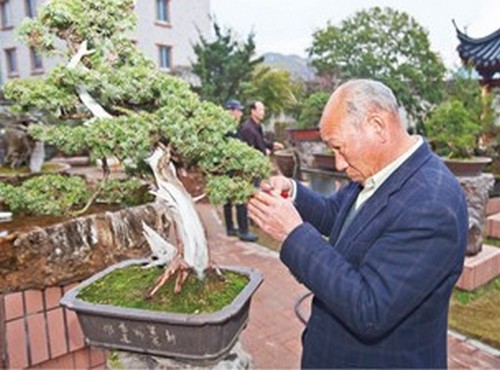
1. Shaping time. According to the growth habits of Chinese juniper, shaping can be done in all four seasons, but because it sprouts new branches in spring and autumn, shaping in spring and autumn is especially best.
2. Selecting the tree. Choosing the tree form is especially key in the Chinese juniper shaping process. Choose vigorous plants with dense mossy branches, tender needles and a full crown. Shapes made from selected vigorous plants are full and thriving, while shapes made from old plants are shriveled and weak. Therefore, the quality of Chinese juniper shaping depends on the tree's vigor. In addition, when selecting the tree, attention must also be paid to the shape around which the shaping will be done. For example: to make horizontally wide shapes such as elephants and trains, choose a tree form with a low body and wide crown; to make round and clustered shapes such as pandas and airplanes, choose a tree form with a full crown and round body; to make vertically tall shapes such as coiled-column dragons and pagodas, choose a tree form with a tall body.
3. Layout. After selecting the right tree, according to the shape to be made, begin to examine the tree. Which part of the shape should be prominent or sunken, which part should use more branches, and which part should use fewer branches, initially lay this out on the crown. For animal shapes, for example, where the head is, where the legs are placed, and where the tail is, just like writing an article, there should roughly be a draft in mind. Through reasonable layout, production becomes easy and smooth, and can be handled freely.
4. Production. In the production of Chinese juniper shaping, the specific process includes steps such as head first then tail, tail first then head, top first then bottom, and bottom first then top; planning such as calculation and fixing frames; and work procedures such as tying, binding, twisting, pinching, pulling, pruning and thinning.
(1) Steps.
1. Head first, tail last. In production, start from the head first, then make the body, and finally complete the tail. The shapes in this step are mainly animal shapes and so on.
2. Tail first, head last. Make the tail first, then gradually advance until the head. The shapes in this step include lions, tigers, elephants, bears and so on.
3. Top first, bottom last. Start production from the top first, then finish the shape at the lower part. The shapes in this step mainly include figure shapes and so on.
4. Bottom first, top last. Start from the bottom first, and gradually produce upward. The shapes in this step include pagodas, pavilions, coiled dragon columns and so on.
(2) Planning.
1. Calculation. Before production, according to the crown, first calculate the data for each part of the shape, such as head volume, body length, leg height and waist circumference.
2. Fixing frames. The important parts of every Chinese juniper shape cannot do without fixed frames. Often the key parts are first made into fixed frames under the tree, and after being securely tied onto the tree, mossy branches are then tied onto the skeleton. Some shapes need a skeleton throughout the whole body, such as pagodas, pavilions and towers. The tying and making of fixed frames can be done according to the size of the shape, simulating the outline of the shaped part, and formed by tying and binding.
(3) Work procedures.
Tying, binding, twisting, pinching, pulling, thinning and pruning and so on are the most meticulous and nimble link in the entire production process. For animal shapes, standing, sitting, running and jumping must be produced through this link, making them vivid and lifelike.
1. Tying: use hemp rope or nylon rope to tie scattered branches together in one place, highlighting the shaped part.
2. Binding: use fine binding wire (No. 22 to No. 24) to arrange and bind the mossy branches in order, showing that the shape is full and round.
3. Twisting: when the branch body is biased, twist it into use.
4. Pinching: bend branches straight or pinch straight branches curved as needed.
5. Pulling: pull branches from one place to another for use.
6. Thinning: thin out excess and useless branches.
7. Pruning: when shaping is finished, prune the whole body.
To make Chinese juniper shapes well, one should look more, practice more and weigh things over more. It is hoped that the broad community of enthusiasts will work together to make this ancient folk art of Chinese juniper shaping shine with even more brilliant splendor.