Cultivation Methods and Techniques for Elm Bonsai
Chinese elm (Ulmus parvifolia) is usually propagated by seed. The seeds ripen from October to November, when the samaras turn yellowish-brown; they should be collected promptly, spread out to dry in the sun, winnowed to remove debris, and stored dry in bags. Sow in March of the following spring, either by broadcasting or in drills. For drill sowing, the row spacing is 25 cm; choose a windless, sunny day for sowing, then cover with fine soil just until the seeds are no longer visible, and cover with rice straw. They will sprout and emerge in about 30 days; remove the straw promptly and thin the seedlings appropriately. During the growing period, manage watering and fertilizing well, weed and loosen the soil; seedlings can reach 30-40 cm in height in the same year. Young saplings have thin trunks and sparse branches with relatively large leaves, so they are generally not suitable for making bonsai; it is better to grow them for several years, then prune and shape them before potting. In addition, Chinese elm can also be propagated by root cuttings to produce material for stump bonsai, with faster results; this is used fairly widely in South China.
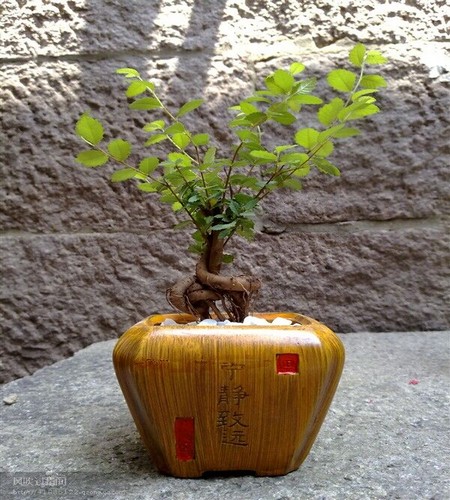
When Chinese elm is grown from wild old stumps dug up from the field, it generally takes at least 2-3 years to take shape. Here is a rapid cultivation method that is especially suitable for bonsai growth. The Chinese elm stumps dug up in early spring are first planted in clay pots for cultivation; once established, unwanted buds should be removed at any time, and shaping begins from late April to early May. When the branches grow to 15-18 cm long, use fine metal wire for bending and styling, and pay attention to care and management. When new shoots grow 4-6 leaves, pruning can be carried out; generally only two leaves are left on each small branch, and then a nitrogen fertilizer is applied immediately to encourage the new shoots to send out new buds again. Repeat this pruning and fertilizing many times so the leaves grow dense as quickly as possible. As the branches keep thickening, the metal wire must be removed in time to prevent "wire bite". For branches that have not yet taken shape, they can be bent again to fix their form. In this way, by September a pot of Chinese elm stump bonsai can take preliminary shape.
The key to this rapid shaping method is mainly to do the bending while the xylem of the branches has not yet hardened, so special care must be taken during the work, and the thickness of the metal wire must also be chosen appropriately; when wrapping, it need not be pressed too tightly, to avoid bruising the tender branches. In addition, the work of "growing the stump" must be done well, so as to achieve the goal of potting up and making bonsai in the same year the stump is dug.
Freshly dug old elm stumps should be planted in plain sandy soil in the ground or in clay pots for "stump growing". This is generally done from late autumn to spring (the survival rate is highest in the two or three months before bud break). Before planting, first prune the root system and branches and trunk; sticky sap often flows from the cut surfaces. If too much sap seeps out, it will seriously affect the survival rate. You can seal the cuts with paint or wax, or coat them with a layer of erythromycin ointment or sulfonamide ointment, then sprinkle on fine sandy soil. After planting, pack the soil down as much as possible; there is no need to water, only spray the branches and trunk with clear water 1-2 times a day, and after 3-4 days water once thoroughly. After that, do not water unless the soil is dry, and strictly prohibit waterlogging in the soil.
Secondly, when styling an elm bonsai, based on the basic form of the old stump, use wiring, pruning and so on to create different styles of bonsai, such as formal upright, curved trunk, slanting trunk, semi-cascade, cascade, wind-swept, forest, and root-over-rock. Styling can be done during the dormant period after leaf fall or during the growing period, but the bud-break period should be avoided.