Fast cultivation method for wintersweet bonsai, a step-by-step guide
Wintersweet (Chimonanthus praecox) belongs to the family Calycanthaceae and is a deciduous shrub with opposite leaves and a rough leaf surface. The flowers are borne on new shoots (i.e. current-year shoots) that grow from the leaf axils of the previous year's branches. The flowering period is from December to February of the following year, and the fruiting period is from August to September of the following year. It is highly adaptable, drought-tolerant, cold-tolerant, light-loving, fertilizer-loving, and not tolerant of sooty mold. It tolerates pruning. It is afraid of wind, waterlogging, alkaline soil, and clayey soil. Wintersweet is divided into two types: pure-hearted wintersweet and mixed-hearted wintersweet. Its grafting propagation and cultivation methods include the following:
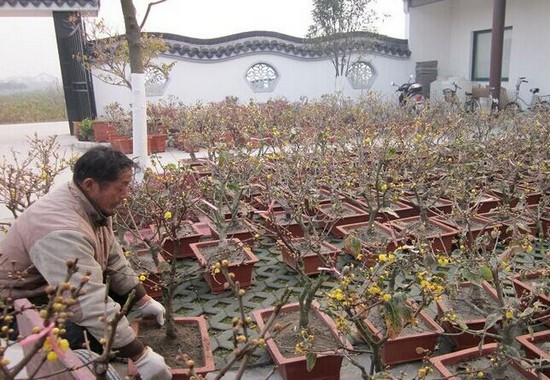
1. Seed propagation: Harvest the urn-shaped receptacles in July-August, take out the seeds, and sow them immediately after harvesting; they germinate in about 10 days.
2. Division propagation: This method is mainly used when propagating pure-hearted wintersweet. Because its roots send up dense suckering shoots, all can be divided. When planting, choose a sunny, high, and dry location, and do not plant too deep. Shorten the branches and apply some dilute fertilizer, and they will grow more easily.
3. Field cultivation: If field-grown wintersweet is left to grow naturally, the branches will become messy and crowded, and the tree shape will be poor. Therefore, single-trunk cultivation is generally used. One year after planting, select and keep one strong branch, mound soil and apply fertilizer, and cut off all the other branches. Within the year it can reach 1-2 m in height.
4. Old-root grafting: The cut-grafting method is slightly better than the approach-grafting method. One month before cutting, first remove the terminal shoot so that nutrients concentrate in the middle part of the branch. The scion should not be cut too deep; it is suitable to just slightly expose the xylem. Cut the rootstock off 3-6 cm above the ground. Do not cut the rootstock too deep. After grafting, bind with hemp. Finally, mound broken soil at the graft union into a steamed-bun shape until the top of the scion is covered. The soil is best kept half-dry and half-moist. After one month, remove the mound to help the buds grow, and at the same time cut off the sprouts on the rootstock. If the weather is bad, mound the soil up again.
Measures for successful rooting of thick-trunk cuttings:
The cutting site should avoid direct sunlight and water accumulation; wintersweet tolerates shade and fears moisture. The growing medium can be a mixture of river sand, garden soil, and leaf mold at 1/3 each. Before use, expose it to sun and freezing, which can eliminate pests, reduce weeds, and prevent infection and rot. Select cutting trunks. There are many wintersweet varieties; the survival rate is highest for wild wintersweet (dog-tooth wintersweet), which can reach more than 95%, followed by pure-hearted wintersweet, which can also reach more than 95%. Excellent varieties such as 'Xinkou' and 'Hehua' have lower survival rates. Take thick trunks more than one year old with more bud eyes and saw them into lengths of 15 cm—25 cm, depending on thickness. Cutting method: cut off the branches on the thick trunk to prevent too many new buds and nutrient consumption (when sprouting, keep only two or three shoots and peel off the rest). Seal the upper and lower wounds of the thick trunk with candle wax to prevent infection and rot. Insert into a seedbed or flowerpot, preferably leaving only 1 node—2 nodes of bud eyes above the soil surface (oblique cutting is also possible, which makes approach-grafting easier after survival in early autumn). After insertion, water thoroughly. Be very careful to keep warmth and moisture, and do not expose to wind or sun.
Measures for rapid shaping: After thick-trunk cuttings of pure-hearted wintersweet sprout and send out shoots, when they grow 2 pairs—4 pairs of leaf buds, pinch the tips 2 times—3 times; they can then be shaped in the same year. Prune heavily once the following spring, and after 2 years—3 years the branches will be full of abundant flowers, warm and lovely. For thick-trunk cuttings of wild wintersweet (dog-tooth wintersweet), its vitality is strong, it sprouts quickly, and the survival rate is high. Wait until the shoots grow 4 pairs—5 pairs of leaves, then pinch the tips. By before early autumn, the base of the sprouted shoots has already become lignified. Approach-grafting or detached approach-grafting can be carried out. Select scions from shoots that sprouted this year and, after pinching, have branched and already formed flower buds. After approach-grafting, such shoots will continue to grow 2 leaves—3 leaves; pinch the tips again, and stop pinching in early August. In the same year, a small bonsai is formed, and there are flowers to enjoy.
Management after approach-grafting: when two plants are approach-grafted, the rootstock is a cutting from the same year. Although it has survived, its root system is not well developed, and some have just rooted, so it should be placed in a ventilated, shaded place. For detached approach-grafting, even more attention should be paid to avoiding sunlight, and a plastic bag should also be put on to preserve moisture. For approach-grafted or detached approach-grafted plants, the branches and leaves at the upper end of the rootstock cannot be cut off in the same year, so as not to affect survival and growth. Pay attention to water and fertilizer management. At the time of approach-grafting, rainwater must not enter the wound, to prevent decay. Do not water if not dry; when watering, water thoroughly. Fertilizer should mainly be dilute cake fertilizer and manure water. For two-plant approach-grafting, cut off the scion part after two months. For detached approach-grafting, the moisture-preserving plastic bag can be gradually removed after 15 days—20 days, and the plant placed in a shaded, ventilated place for careful management.
This method of cultivating wintersweet bonsai uses only 1 year—3 years to obtain a wintersweet bonsai with a thick, unusual trunk, beautiful shape, brilliant color, and rich fragrance. Placed in the hall, it truly has the reputation of “a silent poem, a three-dimensional painting.”