How do you shape a bonsai? A few practical methods to teach you
Bonsai is a decorative art with a long history in China. It involves taking woody plants, herbaceous plants, or water, stones, and the like, and through artistic processing, planting or arranging them in a pot to make them a miniature of nature. According to the different materials used, bonsai can be divided into two major categories: tree-stump bonsai and landscape bonsai. Bonsai has high ornamental and artistic value and is deeply loved by people.
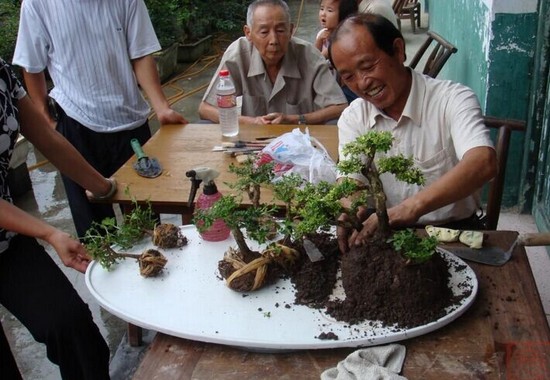
Bonsai can be called a small miniature of a great tree in nature. In other words, it re-displays within a limited pot the natural charm of ancient and famous trees with beautiful forms growing in mountain forests and the wild. Therefore, the size of the trunk, the size of the leaves, and whether the tree shape is neat or not all have a great deal to do with whether it looks visually harmonious.
1. Root spread
The primary condition of a fine bonsai is the root spread. It can be said that the root spread is essential and very important in creating a natural tree shape for the entire bonsai. Whether the root spread is beautiful or not has a decisive influence on the artistic value and appreciation value of the work. The beautiful root spread referred to in bonsai is the root at ground level below the base, extending in all directions, sometimes curved, sometimes hidden in the soil, lying tightly against the ground, so as to keep the potted tree from producing any instability. The commonly mentioned "root spread on all four sides" is precisely the most beautiful root spread.
2. Base
Under normal growth conditions, the extension of the trunk toward the top of the tree, at the junction with the root section, should generally, with few exceptions, be a natural base. Specifically, it is the thick trunk about three cun in length starting from the root spread. Trees used to make bonsai originally grow in mountain forests and beside rivers and streams. Beaten by wind and rain, the trunk will more or less become bent, especially trees growing on cliffs and precipices, whose trunks sometimes bend to an extremely large degree, but the base is not affected by external forces. Generally, the trunk of a potted tree is upright. Sometimes, to meet the needs of the tree shape, when changing the curvature of the base, there should be an appropriate degree, and it is best that there is no obvious feeling of unnaturalness. This is because the base, like the root spread, is one of the indispensable and important conditions for displaying the beauty of bonsai.
3. Trunk
If a bonsai is compared to a person, then the trunk is the body of the bonsai and the basic condition for shaping the tree form. In a natural, normal large tree, the closer the trunk is to the root, the thicker it is, and the closer it is to the top, the thinner it is. This naturally tapering round trunk, thick to thin, is the most ideal. Whether the trunk is more beautiful when thick and large or more elegant when thin and small varies greatly according to individual differences in appreciation. However, whether the trunk should be thick or thin should depend on the structure of the overall tree shape and must be coordinated with the root spread, base, branches, leaves, and so on. Regardless of whether the trunk is thick or thin, as long as it can match and harmonize with the overall tree posture, it can naturally produce a balanced beauty. Generally speaking, the thickness of the trunk should harmonize with the age of the tree being expressed; only in this way can the layered beauty of the bonsai be displayed.
5. Bark character
Bark is like human skin. There are many kinds: coarse bark that splits vertically and peels, tortoise-shell bark in the shape of a turtle shell, rock-like bark with overlapping layers... Viewed alone, this bark has no beauty to speak of, but when set off by the trunk, root spread, and overall tree posture, it can display a charming atmosphere of antiquity and rugged strength.
6. Leaf character
The shape, character, and size of bonsai leaves are collectively called leaf character. Leaves are indispensable to bonsai. This is because a potted tree often produces different impressions depending on whether the leaf character is good or not, especially for deciduous trees of the miscellaneous-wood type. When spring arrives, new buds begin to emerge on the branches, then leaves open; by autumn the leaves gradually turn yellow and finally fall. From the four-season changes of the leaves, people can clearly experience the shift of the seasons and feel the splendor of natural style.
Trees in nature, because of different growing environments, have endlessly varying postures, and this is reflected in even richer and more colorful forms in tree bonsai. From the perspective of tree bonsai shaping, we summarize and merge similar or roughly similar bonsai forms, and then classify and explain them mainly based on the changes in the main trunk of the tree and the number of trees.
(1) Formal upright style
A bonsai tree has only one trunk, and the posture of the trunk is basically upright or slightly curved; that is, so-called cases in which straightness contains a sense of curve are all called the formal upright style. Formal upright style bonsai trees require that the best expression of the roots must be thick roots extending in all directions, making the tree appear solemn and stable, with the momentum to stand firm between heaven and earth. The branches extend in all directions, with rich layers and strong branch momentum.
Branches should preferably emerge at about 1/3 or about 2/3 of the height of the main trunk, and there should not be too many branches and leaves, so as not to block the main trunk. The main trunk should be left more exposed to show the uprightness and rugged strength of the potted tree. The pot should preferably be shallow, and the planting position depends on the tree shape. Note that there should be an asymmetrical balance between the tree and the pot.
If the crown is an isosceles triangle, the planting position should preferably be centered and toward the back; if the crown is slightly a scalene triangle, the planting position should preferably be slightly toward the short side of the triangle. Formal upright style tree bonsai should preferably be made into tall "vertical-format" picture works, and the branches should preferably be short. Tree species suitable for expressing formal upright style works include black pine, five-needle pine, golden larch, dawn redwood, ginkgo, elm, and so on. Most of these materials are taken from forest farms and nurseries, and some are dug from mountain wilds.
(2) Curved-trunk style
Curved-trunk style bonsai trees require the main trunk to have a certain degree of bending variation, but the curves should not be many; one or two bends are enough. The curves should avoid overly monotonous repetition; otherwise there will be traces of artificial contrivance.
The value of the curve lies in its liveliness, and liveliness lies in the variation of the main trunk line having both hardness and softness, combining hardness and softness, with lines that are both smooth and graceful and upright and vigorous. Curved-trunk materials collected from mountains vary unpredictably and are rugged and natural, very precious, but there are also unsatisfactory line variations, so attention must be paid to selection.
For artificially cultivated curved-trunk materials, when planting, the main trunk must be slightly slanted so that the roots on the other side can be cultivated into thick, strong roots half exposed on the soil surface, and so that the direction of the roots and the place where they connect with the main trunk give a feeling of smooth coordination completed in one continuous flow. This is the most important ornamental part of a curved-trunk style tree bonsai and must be given great attention.
For the part above the base of the main trunk, it can be shortened by pruning so that the main trunk chooses a new direction of development. Later, a combination of pruning and wiring can also be used to cultivate the main trunk until it meets the beauty requirements of bonsai. Cypress is the most typical material for curved-trunk style bonsai. Other trees, such as pine trees and some miscellaneous-wood species, are also suitable for making curved-trunk style bonsai.
(3) Slanting style
In nature, trees with slanting trunks are mostly caused by strong winds or by factors such as mountain collapses and landslides. Therefore, the changes in the form of slanting tree trunks are also very complex, but one thing is certain: the trunk line is not a straight line, but various deformations in an "S" shape. Reflecting this slanting trunk posture from nature in tree bonsai is what we call the slanting style.
The main trunk of slanting style bonsai material must have various "S"-shaped deformations. If the main trunk leans to the right, then there should preferably be thick roots on the left side, and the tip of the main trunk should turn upward; only then does it look like slanting style bonsai material that has leaned for many years. If the main trunk slants but the trunk line is straight, then it lacks charm and does not conform to natural laws. This is because there is no day in the world when strong wind never stops, and trees always continue to grow upward.
The key point in making slanting style tree bonsai is how to keep the tree's momentum from losing its center of gravity and to achieve balance. The methods include: making use of thick roots in the opposite direction, making use of branches in the opposite direction, and having a large branch on the same side as the slanting trunk droop downward, giving people a feeling of support. To strengthen the force of the potted tree's slant and make the composition lively, it is preferable to choose a round shallow pot, a square shallow pot, or a half-height round pot, and let the slanting trunk or branches extend beyond the pot. Pine and cypress trees and some miscellaneous-wood trees are all suitable as material for slanting style bonsai.
(4) Cascade style
On natural cliffs and precipices, it is common to see trees growing in various postures, perilous in the extreme yet still flourishing. Trees with this kind of posture, reflected in bonsai, are collectively called cascade style.
Cascade style generally includes semi-cascade style, full cascade style, and inverted-hanging style, and so on.
Semi-cascade style: the whole bonsai tree extends beyond the pot, rising across the air, but the tree body is not lower than the pot surface. It may have a horizontal main trunk, or because the main trunk is relatively short, the first branch is relatively thick and long, thereby taking momentum in the air.
Full cascade style: the whole bonsai tree extends beyond the pot and stretches downward in a pouring manner while the branches extend horizontally.
Inverted-hanging style: the whole bonsai tree extends beyond the pot, the exposed main trunk hangs vertically downward, and the branches still extend horizontally.
The making of cascade style bonsai focuses on material selection. The base of the material's main trunk is required to have a certain bending variation so that the main trunk or large branches can smoothly extend horizontally or droop. Although cascade style bonsai is attractive, it must not be considered without regard to the conditions of the material; one should follow the shaping principle of "suiting measures to the material."
Cascade style bonsai used to be commonly grown in flower pots to set off the momentum of the tree falling from a height. Now it is more often grown in half-height square pots or round pots, and during exhibition arrangement a tall stand is used to create the cascade momentum. Its advantage is that it can improve the situation in which a tall trunk pot is too deep and thus unfavorable for tree cultivation and management; in appreciation, it can make the scenery, pot, and stand a trinity and display it thoroughly, thereby making the picture transparent, coordinated, and vivid.
(5) Double-trunk style
Double-trunk style tree bonsai appears in the form of two trees combined together, embodying the artistic beauty between the two trees of mutual yielding and coordination, looking back and responding to each other, appropriate density, and the mutual generation of emptiness and solidity, thereby displaying a realm in which the work has both form and spirit and blends feeling with scenery.
The making of double-trunk style bonsai must pay attention to the following key points.
1. Material selection: the two trees must have a distinction between primary and secondary.
The main tree should be taller, and the secondary tree should be shorter. The posture should be dominated by the main tree, and the changes in the posture of the secondary tree's main trunk should be roughly similar to or close to the posture of the main tree's trunk, so as to form a certain tacit understanding. If the changes in the posture of the two trees' main trunks are completely different, such as one straight and one curved, it is difficult to produce a coordinated beauty and should be avoided.
2. When planting, the two trees must have a front-back relationship and must not be parallel.
Which is in front and which is behind depends on the specific situation. When planting, the bases of the main trunks of the two trees should be close, and the direction of the trees' roots should be basically consistent, not each going its own way. The angle between the extending directions of the two main trunks should not be too large; generally within a 45° angle is relatively ideal. If it is too large, the two main trunks may lose their mutual response and looking back. Branch treatment: the selection and adjustment of branches in double-trunk style is relatively complex. The two trees must be treated as a unified whole in order to achieve overall balance and stability, coordination of emptiness and solidity, and orderly contention and yielding. The large lower branches of the two trees should each extend outward, and thicker branches between the two trunks should be pruned away to avoid thick branches crossing the main trunks. The branches between the two trunks should be filled in by branches from the front and back sides to avoid going straight back and forth; only in this way is it most natural. In addition, the main tree's branches should preferably emerge high, while the secondary tree's branches may emerge slightly lower, so as to avoid the main tree's branches affecting the growth of the secondary tree.
3. Double-trunk combined planting can also be two different tree species, but the best combination is still one tree species.
Double-trunk style is the combined planting of two trees, and the form of one tree with two trunks can also be included, collectively called double-trunk style. This is because, from the perspective of shaping, their trunk treatment and branch treatment are the same. One tree with two trunks may originally have been one body and later split into two under external influence. The height, thickness, straightness or curvature, and changes in concealment and exposure of the two main trunks all very much conform to the expressive requirements of bonsai art. The deadwood trunk is also naturally formed, with a little removal of rot and embellishment. Divine branches are indispensable, but are artificial. It is most ideal if the two water lines are broad and both grow on the outer sides of the trunk. The crown is formed by the tight combination of two crowns, and its momentum is unified with the two trunks. The whole tree is appropriately dynamic and static, compact in structure, and has a beauty of steadiness, calm, unity, and harmony.