Essential Techniques and Styling Methods for Creating Chinese Arborvitae (Platycladus orientalis) Bonsai
Tip pinching and shari (deadwood) are important techniques that must be mastered in creating Chinese arborvitae bonsai. Tip pinching is essentially leaf pinching. Because the young branches of Chinese arborvitae develop from scale-like small leaves, removing the tender shoots and leaves can control rampant growth. At the same time, the tips are also the only choice for organizing the crown form, standardizing the tree's appearance, and beautifying the landscape. It is usually carried out on the basis of trunk chopping and branch cultivation, and works in conjunction with wiring.
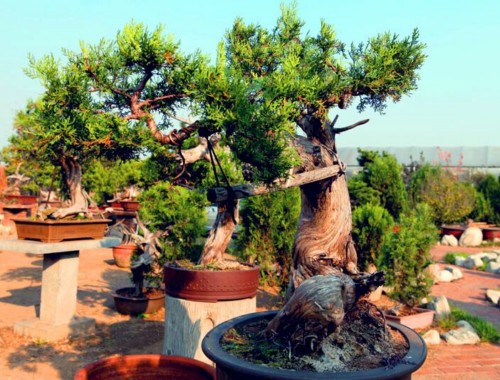
Shari and jin (deadwood branches) give Chinese arborvitae more connotation, fully displaying the towering spirit and heroic bearing that has endured countless trials in the baptism of nature and stands tall against the heavens. Many Chinese arborvitae bonsai specimens have dead tips on top, scars below, and decayed holes at the base; or the growing layer has been extensively killed by borers, or the trunk has many cuts from knives and axes with overly exposed cut ends. One can follow nature's course and use shari techniques to transform ugliness into wondrous beauty. Shari can be applied to parts that are already dead or can be made to die, and can also be applied to twisted yet beautifully spiraling trunks and branches, or implemented when needed for line and color contrast.
Bark stripping is best done in mid-spring, carving is best done in winter, and jin (deadwood branches) are best made by twisting. One must grasp the contrast between the dead and the living, and grasp the viewing side. However, doing shari should proceed from practical reality; the key is to examine the specimen tree and see whether it is necessary and possible. Shari techniques should not be overused, otherwise one will outsmart oneself and achieve the opposite. The art of bonsai has no fixed rules and no fixed forms. Practitioners have different levels of cultivation and different styles. Every single move depends on the author's inspiration and inner drive to accomplish. In the styling of Chinese arborvitae bonsai, one should expand exchanges in practice, perfect oneself, earnestly sum up experience, and constantly innovate.
After a Chinese arborvitae specimen tree has survived, it needs at least one to two years or even longer of careful maintenance to grow the top branches vigorously, the side branches strong, the leaves full, and to cultivate branches and roots until lush, before wiring and pulling can be done. Chinese arborvitae can be styled into various forms, but styling requires insight and figurative thinking. The Yellow Emperor's Mausoleum cypresses in Shaanxi and the Han cypresses of Dai Temple are regarded as national treasures for their unique character, natural charm, and rich historical and cultural connotations. Their solid and majestic image is precisely our model and good teacher for styling and landscape creation. Image is character, is strength of spirit, is charm.
In styling Chinese arborvitae, one must respect the tree's nature and respect its image. Most high-level Chinese arborvitae bonsai have trunks that are twisted and powerful, ancient and peculiar; roots extending in four directions, with a nature to penetrate the ground; leaf forms in clusters; the crown either like clouds condensing rain, or like layered green peaks, mostly triangular and scalene triangular. Chinese arborvitae styling is extremely suited to a dignified appearance, containing movement within stillness, with a far-reaching artistic conception. Its style should emphasize a scholarly air. Techniques should maximize strengths and avoid weaknesses; absorb from both north and south, and be flexible and varied.