Detailed Explanation of the Key Points of Stump Bonsai Pruning Techniques
Stump bonsai is a living work of art created by planting old woody plants in pots and, through years of artistic processing such as pruning, wiring and fertilizing, along with meticulous management, giving the trunk rugged strength and the branches and leaves lush green foliage. It does not take its final form from the initial artificial styling, but instead grows and changes continuously according to natural laws, therefore, routine care and management are very important.
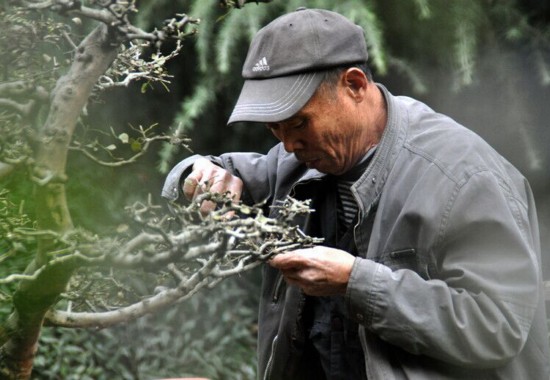
Pruning: Bonsai trees are still growing continuously. If they are allowed to grow freely without restraint, it will inevitably affect the tree's form and cause it to lose its artistic value. Therefore, timely pruning is necessary: shorten long shoots and thin out dense ones to maintain a beautiful tree form and appropriate proportions. For bonsai that have already taken shape, measures such as pinching, tip pruning, branch thinning, bud removal and leaf removal must be adopted according to the respective tree species to keep them in a wonderful posture.
Branch pruning: Bonsai trees often produce many new branches. To maintain their beautiful form, attention must always be paid to pruning. The pruning method should be decided according to the tree form; for example, for a cloud-layer form, the branches are pruned into a flat shape. Generally, dead branches, parallel branches, crossing branches and the like that spoil the appearance should be cut off promptly. In particular, for stump bonsai with shaped branch pads, new shoots often suddenly appear during the growing season, and these protruding branches should be cut off promptly to keep the branch pads flat and the layers clear.
Root pruning: When repotting, combine it with root pruning; roots that are too dense or too long should be trimmed, and this can be considered according to the following situations. If the tree's new roots are poorly developed and the root system has not densely covered the bottom of the soil ball, the original pot can still be used for repotting, and there is no need to prune the root system. For tree species with well-developed root systems whose fibrous roots densely cover the bottom of the soil ball, a slightly larger pot should be used, the dense root system should be thinned, old roots removed, and a few new roots retained for repotting. For some old stump bonsai, when repotting, the roots can be appropriately raised to increase their ornamental value. Also prune away old roots and part of the root tips, and bank them with loose, fertile soil to encourage new root growth.
Winter is the best pruning period for deciduous tree species. Careful pruning should be carried out, cutting away drooping weak branches, messy branches, crossing branches, overlapping branches and so on, so that the crown is well spaced with clear layers and in good order. In short, stump bonsai requires long-term care, careful observation and patient pruning to cultivate a beautiful tree form.