Detailed Explanation of the Key Techniques for Pruning and Shaping Azalea Bonsai
Azalea bonsai is a work of art, and in pursuing its artistic character, attention must be paid to the perfect combination and full display of roots, trunk base, trunk, and branches. Generally speaking, the roots and trunk base of azalea bonsai are difficult to change, but the application of branch techniques still offers ample room for expression. Branch techniques can fully be used to improve the structural layout of azalea bonsai, achieving competition and concession, call and response, and mutual regard and anticipation among branch supports, expressing its spirit and enhancing the ornamental effect.
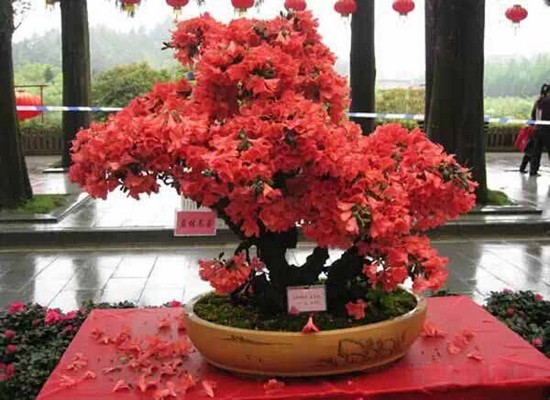
Processing:
After azalea seedlings are potted, processing can generally begin in 3-4 years. Azalea branches are relatively brittle and should not be over-bent; only the main trunk and main branches should be given appropriate shaping, and coir rope binding is better. All other branches should be shaped by pruning. When pruning, attention must be paid to adjusting strong and weak branches: heavy pruning for strong branches, light pruning for weak branches. Binding is generally carried out in spring, when the branches and trunk are more loose and soft during the growing season, making binding easier.
Tree forms:
Common tree forms of azalea include the straight-trunk type, curved-trunk type, and slanting-trunk type, and they can also be processed into exposed-root style, cascade style, rock-clinging style, connected-root style, and so on. Through artistic shaping, a beautiful bonsai is achieved that combines all four aspects: viewing flowers, appreciating the trunk, examining the roots, and discussing the form.
In the application of branch techniques in azalea bonsai, on the premise of establishing the concept and composition, the operation mainly relies on pruning and binding to achieve results. Of course, azalea bonsai is constrained by its own characteristics, and branch technique expression is not as comprehensive as that of miscellaneous broadleaf trees, but commonly used branch techniques such as natural branches, floating branches, parallel branches, dropping branches, and weeping branches are still relatively suitable.
Pruning - First, for branches that have grown in place, cut them off according to the conceived position, then let new branches sprout and grow to a certain thickness before cutting again, repeating this alternation until the desired requirements are met; second, cut off messy branches, thin out branches for ventilation, improve light exposure, and promote growth; third, carry out form-maintenance pruning on finalized works, promptly cutting off branches that grow wildly and affect the aesthetic appearance.
Wiring: This is an important form of branch technique creation in azalea bonsai. The characteristics of azalea raw material are brittle branches and thin bark. Improper wiring treatment can easily break branches and damage bark, at best affecting growth and at worst causing death. For wiring azalea bonsai, attention should be paid to two points:
1. For branches with a diameter of less than 10mm, use metal wire to directly pull and bind them to the ideal position or angle. The specific operation is to first wrap the branch and trunk with black plastic film before wiring, then select metal wire of appropriate thickness according to the size of the branch, wind it tightly, and pull or bind it to the required position. Wrapping the branch with black plastic film serves two purposes: first, the black color provides shade, and accidental bark damage also heals more easily; second, it protects the bark, preventing the metal wire from directly damaging the bark and also preventing the metal wire from scorching the bark at high temperatures.
2. For thick branches with a diameter of about 30mm, carry out the "tendon-and-bone-breaking" operation for shaping. First use a branch splitter to split the thick branch lengthwise along the branch water line into four sides by a certain length, twist and knead it slightly, then wrap it tightly with black insulating tape, and then slowly knead it soft. Before pulling, properly reinforce the branch fork to prevent splitting during pulling. For all branches that have been wired and pulled, timely unbind them after the tree form is fixed.