Detailed Explanation of Artificial Propagation and Cultivation Methods for Azalea Bonsai
The azalea is one of China's top ten famous flowers, widely distributed throughout the country, and is a well-known ornamental plant. The Tang Dynasty poet Bai Juyi once praised the azalea: "Beside it even peach and plum blossoms look colorless, and compared with it the hibiscus seems no flower at all." As early as the mid-16th century, people began to explore the species and habits of azaleas and started domesticating and cultivating them. To date, nearly a thousand varieties of Rhododendron simsii have been discovered, and there are more than ten thousand cultivated varieties of azaleas.
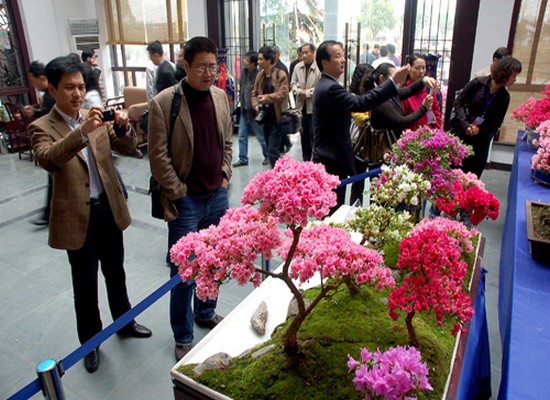
Azaleas can be propagated by sowing, cuttings, grafting, division and other methods. Generally, cuttings are the main method, as the procedure is simple and flowering is also rapid. The best time for cuttings is during the plum rain season. Use current-year branches as cuttings; after new buds have formed, cut them off at the base for rooting, which gives the highest survival rate. If older branches from the previous year are used as cuttings, rooting is more difficult. For azalea cuttings, the seedbed soil should be acidic mountain soil, or dried and weathered pond mud or leaf mold; inserting the cuttings into mountain soil placed in a wooden frame is also acceptable.
For rare azalea varieties, to ensure survival, the cut end can be wrapped in moss to form a ball and inserted into the soil to a depth of about 3-4 cm, which makes rooting easier. After insertion, build a shade frame, water several times a day, and keep the seedbed moist. After about 2-3 weeks, the cut end will gradually heal and root. Once the cuttings have rooted, the light exposure can be increased. After about 2 months, dilute cake fertilizer water can be applied to promote growth. In the spring of the following year, they can be potted.
For propagation by sowing, seeds can be sown in wooden frames or earthenware pots. The bottom of the pot should be lined with vermiculite or leaves to aid drainage. Place mountain soil or leaf mold mixed with an appropriate amount of sandy soil in the pot, level with the rim (slightly below the rim), then sift a layer of fine soil over it, sow the seeds on top without covering with soil, and cover with glass, preferably lined with newspaper, to keep it moist. After about 3-4 weeks, they will germinate and emerge. At this point, remove the glass cover, allow light, and water appropriately. Once the seedlings have developed 3-4 leaves, transplant them.