Detailed Explanation of Pruning Methods and Techniques for Small-Scale Bonsai
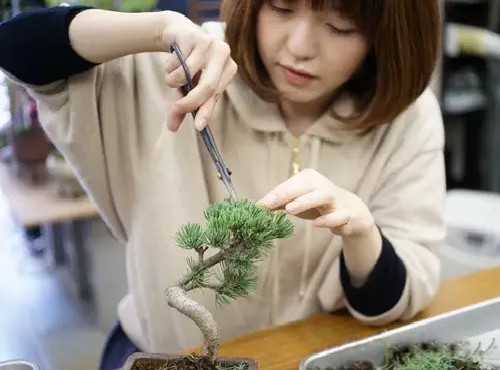
Pruning of small-scale bonsai is synonymous with the means of shaping bonsai trees. Although there are also techniques such as wiring, pulling and hanging, guy-wiring, carving and grafting, they are often conventionally grouped under "pruning." As the main means of bonsai shaping, it not only integrates related techniques, but also contains design concepts and compositional creativity within the "cut." Yet when one thinks about this a little, what matters is not pruning itself, but the shaping principles and related common knowledge expressed through pruning. After all, pruning itself is nothing more than a 45-degree diagonal cut, and it requires the cut surface to be flat, clean and neat. As for rough pruning, detailed pruning and refined pruning, these are merely different stages in the process of shaping and pruning a bonsai tree. Therefore, what matters is the skill beyond cutting, namely "how to prune," and issues such as what to "remove" and what to "keep." In view of this, from a few insights, there are two points worth examining, namely the plant characteristics and the aesthetic characteristics of the bonsai tree.
I. Plant Characteristics
Plant characteristics are rational and scientific, and should not be overstepped at will. Different tree species have different characteristics, and the same tree species differs under specific conditions in different regions and temperature climates, so different pruning methods exist.
1. Unbalanced pruning. That is, not all-round pruning, but a local pruning method adopted according to the plant's physiological characteristics to benefit shaping and healthy branch growth and to avoid pathological branch dieback. It includes thinning cuts and branch control.
(1) Thinning cuts. Generally, when a new raw material has survived and branches are retained to establish supports, excess branches are removed without reservation, so that the retained branches obtain
ventilation and light while the supply of nutrients is concentrated, the branches grow quickly and become robust, and the time for cultivating branch supports is shortened.
(2) Branch control. Generally at the initial stage of branch support cultivation and shaping, due to the plant's phototropism, apical dominance and various other reasons, branch growth is often unsynchronized, with some growing fast and some slow. In order to allow weak branches to develop and grow as quickly as possible, some branches whose proportions are relatively in place must be consciously tip-pruned (removing most of the shoot tips or side branches) for control, so that the weak branches can receive sufficient light and nutrients, lest individual immature branches affect the pruning of the overall shape. The effect of branch control can also extend into the refinement of branch supports and specific shaping work; it is an effective method for adjusting the balanced growth of branch supports.
2. Balanced pruning. That is, all-round pruning, generally when the bonsai tree is close to being formed or before exhibition. At this time, comprehensive pruning can be carried out repeatedly, which not only makes the branches mature and full, but also maintains the beauty of the tree's form.
3. Pruning with leaves. Pruning with leaves means that the retained branch nodes being cut must have leaves, and in particular the bud position determined to be retained on a branch node must have leaves. If there are no leaves, the cut on that branch node should be extended to a leafy place (two or three leaves are enough). By forcing buds, after the retained bud positions have normally sprouted, pruning is then carried out again to the proper position. This is due to the plant's physiological characteristics and the conduction role of the sap it contains. Therefore, in cases such as unbalanced pruning, pruning must generally be done with leaves; otherwise, it may cause shrinkage of the cut or even branch dieback (pruning without leaves is generally all-round pruning, or all-round leaf-stripping pruning, as well as winter pruning of deciduous miscellaneous broadleaf species).
4. Reserved pruning. According to differences in the tree species' wound-healing ability and special circumstances, during pruning, a reserve is made with prevention as the priority, that is, not cutting to the final position in one go, but cutting in two stages, leaving one to two extra bud positions, and then pruning again after the retained buds have grown into fine, robust branches, or when the reserved nodes have naturally withered. For example, Sageretia thea (Chinese sweet plum), Celtis sinensis (Chinese hackberry) and others often use this method in pruning. In actual practice, thick branches create large wounds and are prone to shrinkage, so more can be reserved; thin branches shrink relatively less, so a shorter reserve is enough.
II. Aesthetic Characteristics
Pruning is a means, and how to prune in a way more in line with the laws of beauty is worth exploring. Of course, because each person's personality, temperament and cultivation differ, aesthetic orientations cannot be uniform. But since bonsai is also an artistic category, it naturally has corresponding principles commonly followed, and one must master the application in overall pruning of the aesthetic factors of proportion, angle and outer silhouette contained in the removal and retention of branches in its structural framework.
1. Retain branches to establish supports and remove redundant branches. When cultivating raw stump material, branches and buds grow in clusters, and if removal and retention are uncertain, it is difficult to begin cutting, or if the design concept is somewhat biased, it may lead
to incorrect cutting. Although this can be adjusted, it prolongs the time for cultivating branches and shaping. Because establishing supports is the premise of the structural framework, one should, according to the individual characteristics of the stump material such as upright, slanting, curved, lying, suspended, and waterside styles, integrate the author's conceived imagery, retain branches to establish supports, remove all miscellaneous branches and redundant buds, concentrate nutrients, and cultivate the retained branches, so as to enter the pruning and production stage as early as possible.
2. Coordinated proportions and refined pruning. When branch supports are growing wildly during cultivation, when to prune and to what position should involve a comparison of thickness and length. This runs through the entire process of bonsai shaping and relates to every part of the bonsai tree's structural framework. Among these are the proportion between branches and trunk, the proportions among branch supports, and the hierarchical contrast between primary and secondary veins within a branch support, all of which must be clear before cutting, with a well-thought-out plan and the intention formed before cutting, so that the cut is made and the branch falls exactly as it should.
3. Angular orientation and precise detailed pruning. The angles of branches and buds, the divergent directions of branches, and their staggered arrangement among one another embody the extension, contraction, turning and spiraling of branch supports in space up, down, left and right. If the angle selection is improper, although it can be remedied by wiring, it is ultimately not as good as the natural state. Therefore, when choosing the angle of a bud point, one cannot consider only one aspect and ignore another. That is, regarding the direction of that branch, its spatial state, and its relationships with other branch supports, one must not only be clear, but also conceive "ahead of time" and make judgments, avoiding mechanical, rigid and formulaic work.
4. Outer silhouette control and integrated pruning. The outer silhouette displays the overall tree form of the bonsai, namely what is commonly called a triangular or scalene triangular composition. Here, the length of individual branch tips should be subordinate to the whole, grasping points and lines while integrating them into the overall surface. Observe the whole, prune locally, and adjust comprehensively. At this time the bonsai tree is basically becoming full and mature, and this belongs to the finishing stage of shaping, with its focus on the length and opening-closing of branch supports and the overall relationship of the outer silhouette.
In short, cutting is an observable operation, while how to cut is a latent way of thinking. Only the union of the two is complete pruning. In fact, apart from grasping the plant's characteristics, how to cut belongs to a large extent to the category of artistic aesthetics, and is by no means something that can be covered by the word "cut." As for the above, it is merely several links that pruning should involve.