Detailed Guide to Leaf-Control Pruning Methods for Gardenia Bonsai
Gardenia is a fairly easy bonsai species to get started with. It tolerates pruning well, full sun is no problem, and growing it in shade rarely causes major issues (it just grows poorly). It tolerates waterlogging, so heavy watering and heavy feeding are fine, and a bit of dryness is fine too.
When it comes to Japanese shohin bonsai, players generally choose it for 2 reasons. First, the cultivars are impressive, so they play for the cultivars. Second, the material is refined, so they play for quality. Because of this, many people fall into. Just like Japanese black pine, five-needle pine and so on, Japan also has many gardenia cultivars. I am often asked, what cultivar is my gardenia, or do you have such-and-such gardenia cultivar? Things like Daruma, Seiyo, and now even Issun Boshi and so on.
Here, I want to use my own personal experience to explain something. For gardenia, remember this: do not be superstitious about cultivars (I myself was once quite keen on certain cultivars). The reason is simple: gardenia needs constant pruning (a management approach completely different from many shohin cultivars; five-needle pine needles once a year, and the inherent cultivar determines needle length and form; black pine has a second flush of buds so it is not a concern). Without pruning, whether it is Issun Boshi or Hansun Boshi, it is all empty talk. An ordinary maruba gardenia, after 2 or 3 rounds of pruning, will beat your so-called Issun Boshi by several streets. Even after the "master" is pruned, it still looks just like that. How much is one sun? 3.33cm? So long!
Finally, by the way, posting this does not mean cultivar improvement is a bad thing, or that those cultivars are bad. I am only discussing this from the angle of my own understanding of gardenia. To understand this plant, you do not need to blindly chase cultivars! What you need to pursue more is whether to cut the trunk or not, how the healing is, how the branching is, age, root base and other solid things. Of course, some hardcore enthusiasts like to collect many gardenia cultivars, so I will not mention that. I am only speaking to ordinary enthusiasts.
Also, the Daruma gardenia mentioned earlier is the round-leafed one. This cultivar has basically already been phased out in Japan. The reason is that the leaf veins are too obvious, and the leaves often wrinkle (Kiyotama gardenia is the same). Therefore, it easily traps dirt and grime, and can also trigger some pest problems. That is one point. The second point is that it is determined by the leaf shape of this gardenia cultivar, because the leaf tip is round, and moreover shield-round, meaning the leaf tip end is very wide and broad, then gradually narrows toward the leaf base. For a sun-loving gardenia, this kind of leaf nature is extremely unfavorable for both light exposure and ventilation!
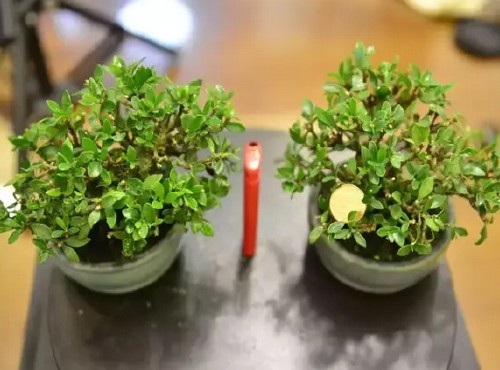
These are two gardenias I hard-pruned in early July, the forms after pruning. I did not combine it with leaf plucking, because I had already calculated that there would be a flush of growth in summer, and there would be another round of pruning before winter. Below are photos 2 months later, around mid-September. Then in the following pictures everyone can see what the gardenias with heavy watering and heavy feeding and sufficient sunlight grew into after 2 months.
The effect is very obvious. This can probably be called quarter-sun Boshi, hahaha~~~~ After this round of pruning in September is finished, basically no major pruning is done. This September round of pruning is auxiliary pruning and heavy plucking. In November, look at the growth situation, and at most, at most, pluck some strong branches and leaves. Practice brings true knowledge. I hope everyone can grow gardenia bonsai well and learn and improve together. Perhaps what I said is somewhat one-sided.