How to shape a Japanese maple bonsai? Detailed technical points
Aceraceae Acer genus, deciduous small tree, bark dark gray, branchlets slender; young branches green, thin and weak. Flowers purple, samaras purplish red when young, light brownish yellow when mature, the two wings spreading at an obtuse angle. Nutlets spherical, veins prominent; wings and nutlets opening at an obtuse angle. Sun-loving, prefers warm and humid climate, not strongly cold-hardy. Mainly distributed in the Yangtze River basin of China, as well as Korea and Japan.
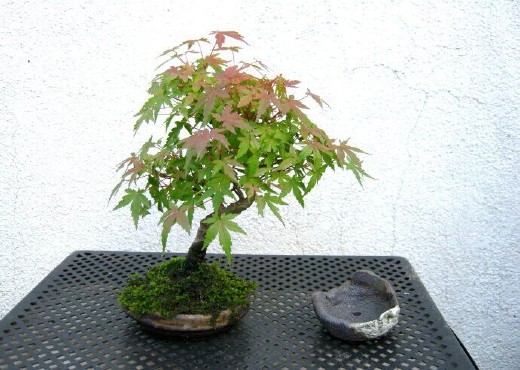
The Japanese maple (Acer palmatum) has beautiful foliage, turning bright red after autumn, its color as striking as flowers and as brilliant as rosy clouds. It is an excellent foliage tree species, suitable for specimen planting, group planting and mass planting. With graceful form and strong ornamental value in spring and autumn, it is often used as a focal plant in main landscape areas. It is suitable for open woodland lawns and courtyard planting, and is commonly used as a front-layer planting in front of evergreen trees. The following introduces the shaping techniques for Japanese maple bonsai.
Processing:
The Japanese maple is mostly shaped by combining wiring with pruning. For wiring, coir rope is preferred, and it must be removed in time, otherwise the wire can easily cut into the bark. If metal wire is used for wiring, it is even more necessary to prevent the wire from cutting in. Wiring and shaping are best done during the plum rain period or after leaf fall. The large branches of the Japanese maple can be wired, while the small branches should be pruned. Generally, each branch is kept with 1 to 2 nodes, and the front end is cut off, so that the two lateral branches that grow form a Y shape, and then pruning is carried out in this way in turn, finally forming the crown.
Tree form:
The Japanese maple is suitable for being made into a combined planting style or a forest style. As a specimen planting, it can be made into tree forms such as slanting trunk style and curved trunk style. The leaves are elegant in shape, red and colorful, quite beautiful.
In making the combined planting style, attention must be paid to handling the primary and secondary, sparse and dense, high and low, near and far aspects. The layout of the combined planting style of the golden larch (Pseudolarix amabilis) can be used as a reference. The difference is that the golden larch mostly has straight trunks, while the Japanese maple often has curves, so when planting in combination, attention must also be paid to the direction and degree of trunk curvature, so as to achieve unity and harmony.