A Detailed Guide to the Processing and Shaping Methods for Bonsai Tree Stock
Seedlings grown from a young age generally begin to be processed and shaped after about 3 to 5 years; for tree stumps collected from the mountains and wilds, most can be processed and shaped after just one year of stock cultivation. Before processing, field-grown tree stock can be dug up and temporarily planted in a pot of basically suitable size, to make it easier to work with and shape. Large tree stock can also be processed and shaped on the spot. Processing and creation must follow a whole series of artistic techniques of bonsai creation: first carefully observe and scrutinize the tree stock material, and based on the characteristics of the material decide what theme to express and how to shape it, which is "treating the material according to its nature." The skeleton of roots, trunk and branches of the tree stock is arranged according to the rules of bonsai art, so that it becomes a living work of bonsai art that is harmonious and well-proportioned, with graceful lines and profound artistic conception.
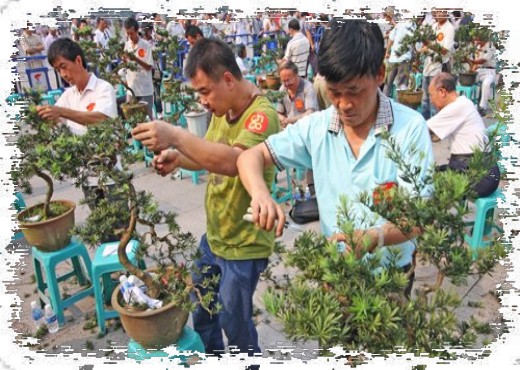
If pine is chosen as the material, it is suitable for expressing the vigor and uprightness of its main root, with branches and foliage spread out flat in cloud-like layers; cypress is suitable for expressing its quaint and peculiar trunk, with branches and foliage in clustered form; plum blossom is best shaped with sparse branches slanting across; winter jasmine is best with drooping, arching branches; ... This is considered from the natural characteristics of the tree species.
In addition, the inherent shape of the tree stump must also be considered. For example, some tree stumps have a straight upright trunk, which can be followed naturally to make a formal upright style; some tree stumps have a naturally curved trunk, suitable for making a curved-trunk style or a cascade style; some tree stumps have a withered, bare trunk, which is suitable for making a dead-peak style ... Treating the material according to its nature can make bonsai creation both labor-saving and full of natural wild charm. If everything is left entirely to nature, then there is no such thing as bonsai art; but if the traces of human work are too excessive, then the beauty of nature is lost. Therefore, for the shaping of tree stumps, one must never rigidly adhere to convention or apply set patterns.
The shaping and processing methods also have a certain sequence: usually the trunk first and then the branches, wiring, pruning or carving from bottom to top, which can be determined according to the needs of the tree species and the style. Due to differences in custom, processing methods also vary from region to region.
Generally, for pines, cypresses and tree species with weak sprouting ability, wiring is the main method. For tree species with strong sprouting ability, such as Chinese elm, Chinese sweet plum, Fujian tea (Carmona retusa) and trident maple, pruning can be the main method. Tree stumps processed by the wiring method can be shaped freely, with varied twists and turns, and take shape relatively quickly; tree stumps processed by the pruning method are vigorous and natural, but take shape relatively slowly. In the southern regions, the climate is warm and trees grow quickly, so pruning is suitable for shaping; in the northern regions, the climate is cold and trees grow more slowly, so wiring is suitable for shaping.
Of course, these are all speaking in general terms. The styles and schools of bonsai differ from place to place, and their shaping methods are utterly distinct. For example, the Lingnan school adopts the pruning shaping method of "storing branches and truncating the trunk"; the Yangzhou school adopts the wiring shaping method of "one cun with three bends"; the Suzhou school uses the shaping method of "coarse wiring and fine pruning"; the Huizhou school adopts the shaping method of "zigzag bending"; the Sichuan school adopts the "square bend" or "dropped bend" shaping method, and so on. If we master the most basic methods of pruning and wiring and apply them flexibly according to specific circumstances, we can often produce ideal results.