Black Pine Bonsai Styling Techniques
Black pine is an excellent material for making pine bonsai, often planted together with plum blossom and green bamboo to form the "Three Friends of Winter" bonsai; if accompanied by rocks, it becomes a pine-and-stone bonsai. A black pine stump specimen cultivated over many years, with its old trunk gnarled and twisted, and its roots intertwined, displays the wondrous posture of a dragon and the soaring of a phoenix, and an indomitable vitality, making it a fine specimen for home cultivation and appreciation.
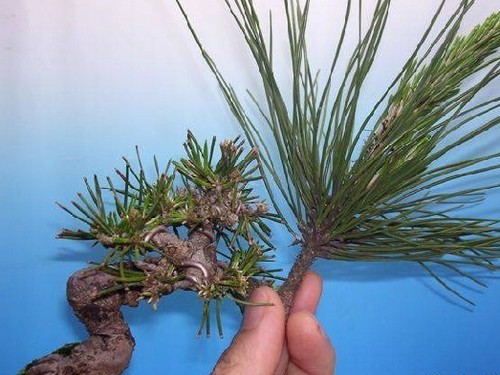
The branches and trunk of young black pine trees are soft and highly malleable, and can be wired according to their characteristics into various styles of bonsai such as curved-trunk style, slanting-trunk style, waterside style, cascade style, and root-over-rock style.
Because the needles of the black pine are thick, hard and relatively long, it is not suitable to prune and wire them into layered pads; the natural form is mostly used, displaying the typical characteristics of a pine tree.
For old stumps, one can, according to the shape of the stump, guide it along its natural tendencies and adapt the form to the material, adopting a method that combines pruning and wiring to create a natural, graceful, vigorous and ancient-looking bonsai. Regardless of the style of black pine bonsai, it must be based on ancient pines in nature and refer to the pine trees in paintings, so that it both conforms to natural laws and possesses a relatively high artistic quality.
The styling of black pine bonsai can be carried out from January to March when the tree sap flows relatively slowly; at this time there is basically no pine resin exuding from the wounds on the branches, and there is little effect on its growth.
The sprouting ability of the black pine is relatively weak, so one should use the existing branches and trunk for hanging and wiring styling, shorten and prune the excess branches, trunk and roots, and adjust their growth direction, adjusting upward-growing branches to a horizontal or drooping form. Except for the formal upright style bonsai, other styles of bonsai should avoid stiff, straight lines in the trunk, branches and roots, so that they combine hardness and softness, with graceful curves.
The black pine has a well-developed root system, and the roots can be raised according to the needs of the styling, in order to display its ancient charm.