A Detailed Guide to the Pruning and Styling Methods for Black Pine Bonsai
The pruning and styling of black pine bonsai is mainly achieved through pruning and wiring; methods such as grafting and forcing buds on young shoots can only serve as auxiliary techniques. The black pine to be styled must have already been cultivated for 1-2 years: the best time for styling is from December to February of the following year. The styling method is mainly hanging and wiring, combined with pruning; metal wire is the most convenient material for tying. The specific contents of the styling work:
(1) Selection and removal of the main trunk and branches; (2) adjustment of the growth direction of branches; (3) correction of the extending posture of branches, as well as the selection of flower placement and determination of planting positions, etc.
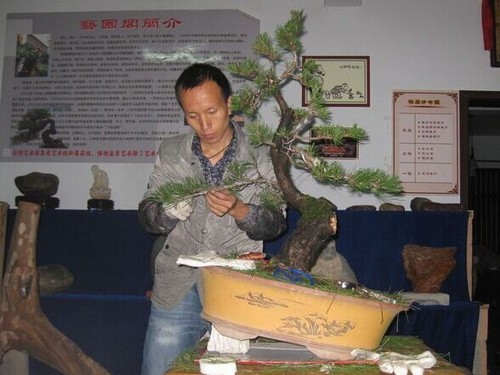
1. Pruning
The pruning of newly planted black pine stump material should be carried out in two steps:
The first step, before and after planting, after careful consideration, branches that are completely unwanted can be cut off from the base; for branches that need to be shortened, do not rush, wait until they have truly survived, preferably the following year, before carrying out the next step of pruning. Moreover, whether a branch that needs shortening can be shortened also depends on whether there are small side branches at the cut point; if there is no side branch that can be retained, new buds will not sprout from the cut like they do on fast-growing species such as Chinese elm.
Therefore, when shortening, a side branch intended for use must be selected well, and after cutting, it should be wired into the ideal position. Of course, it is not that no pine branch can sprout after shortening; if more terminal buds are needed, robust one-year-old young shoots or current-year milk buds can be shortened, which can force out more new buds.
Shaping and processing: mainly by wiring, with pruning as a supplement. After the black pine stump has been grown for one year, it will grow well. The root system is well developed, the survival rate is high, and the resistance to smoke and dust pollution is strong.
Trunk styling: black pine bonsai can be made into slanting-trunk style, curved-trunk style, cascade style and other shapes, and can also be made into root-on-rock style bonsai. Because the needles of black pine are thick, hard and rather long, it is not suitable to prune and wire them into layered pads; natural forms are mostly used, showing the typical characteristics of pine trees.
2. Wiring
Because the regenerative sprouting ability of black pine species is relatively weak, wiring is an important means for this type of bonsai; the method of accumulating branches and truncating the trunk will not work for this type of tree species. Even wiring must be done very carefully, and branches must not be broken or twisted during wiring or pulling. Whether it is a break or a split, the phloem tissue at the wound will not quickly form a covering and continue growing as with fast-growing tree species; instead, it will first die back from the wound to the tip. If there is no living side branch from the branch wound to the base, the water line is cut off, and the entire branch will gradually recede and die back to the base.
Therefore, when wiring, do not use too much force or pull and twist forcefully. If it cannot be completed in one go, proceed step by step. Especially when cultivating large cascade (upside-down) style pine bonsai, on the basis of the stump material's original certain degree of curvature, wiring or pulling must be done in multiple sessions over many years to gradually increase the drooping degree. If it is accidentally broken, ordinary clear lacquer (commonly known as gloss oil) can be used to soak and seal the wound, which may be effective. Black pine takes a relatively long time to set after wiring; once the shape is set, remove the metal wire. If after some years it reverts somewhat due to growth, wire or pull it again.