How to fertilize a rhododendron bonsai for the best results
Yingshanhong, also known as azalea, belongs to the genus Rhododendron in the family Ericaceae. It is an evergreen, semi-evergreen, or deciduous shrub or small tree, and one of China's top ten famous flowers. When spring returns to the earth and orioles call and cuckoos sing, it is exactly when azaleas are in full bloom, with clusters of flowers and abundant spring vitality, delighting the eye and the heart. China is the country with the most species of rhododendrons, with about 530 species. Rhododendrons are extremely diverse, with brilliant flower colors and both beautiful flowers and leaves. They are suitable for both ground planting and pot planting, and are one of China's top ten traditional famous flowers.
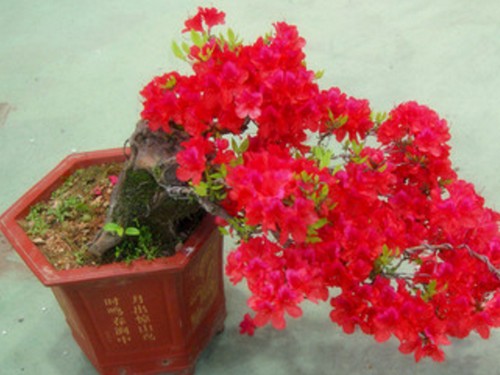
A tiny rhododendron bonsai after one year urgently needs fertilization to replenish nutrients and promote luxuriant branches and leaves. There are many types of fertilizers used, including soybean cake, rapeseed cake, pig, chicken, and rabbit manure, animal hair and internal organs, etc. Put them into a jar, add water, seal it, and use only after full fermentation (more than half a year). When using, it must be diluted with water. Remember to apply thin fertilizer frequently. Rhododendron roots are as small as if the mixture is too concentrated, it will cause fertilizer burn. Each fertilization should be about fifteen days apart. If leaves turn yellow, ferrous sulfate can be added during fertilization or potassium dihydrogen phosphate can be sprayed.
The flowering period of Yingshanhong is in March. Too much or too little fertilization may affect the flowering period and cause seasonal “confusion”, so only planned fertilization can achieve the best flower-viewing effect. After the flowering period, remove the withered flowers and ovaries as soon as possible, and fertilize on time, stopping when summer arrives. Wait until mid-September before fertilizing again; at this time the concentration can be increased slightly, and fertilization should also be controlled in winter. If fertilization is continued, Yingshanhong after the flowers fade will quickly recover its vigor, sprout, and grow leaves. Some Yingshanhong already show new buds emerging in mid-April.
As the temperature rises, combined with the continuous supply of nutrients, the new flower buds will grow larger and fuller day by day. Before autumn is over, the flower color shows itself. Before the little Indian summer of October arrives, they cannot wait to open one after another, and will continue to open until they connect with the formal flowering season of the following year, but by then almost none are left (the author's personal experience). Yingshanhong that blooms off-season like this must go through many years before it can be corrected. Therefore, watering and fertilizing among flower-viewing bonsai is even more of an invisible art.
From flower bud differentiation to bud swelling and flowering, rhododendrons need about 8 to 9 months. Reasonable fertilization is the key link in making rhododendrons flower abundantly and grow lush leaves. The specific fertilization methods are as follows:
After rhododendrons finish flowering, apply nitrogen-based fertilizer 2 to 3 times, once every 10 days, to promote the growth of branches and leaves.
After August, the new branches and leaves become woody. During the key period of rhododendron bud formation, apply phosphorus-based fertilizer combined with nitrogen and phosphorus 2 to 3 times, once every half month. At this time, if no fertilizer is applied, or if phosphorus fertilizer is lacking, or if fertilizers with relatively high nitrogen such as soybean juice are used, rhododendrons will only grow branches and leaves without forming flower buds.
No fertilization is needed during the winter dormant period. Before flowering, apply phosphorus-based thin fertilizer combined with nitrogen and phosphorus 1 to 2 times, so that the flowers are large and brightly colored when they bloom. At this time, the fertilization concentration should be low; too concentrated will cause the flower buds to scorch and fail to bloom.