Detailed explanation of the styling methods for Vitex negundo bonsai, teaching you how to create a beautiful tree shape
Vitex negundo, also known as yellow vitex twig, is widely distributed in China and has extremely strong vitality. It is one of the commonly used miscellaneous tree species for making bonsai. It is highly adaptable and not demanding on soil. For potted Vitex negundo, loose-textured, well-draining humus soil is best, and the planting pot should preferably be a clay pot or cement pot. Before planting, cut off damaged roots and excessively long roots, and cut off leggy branches and overly dense branches.
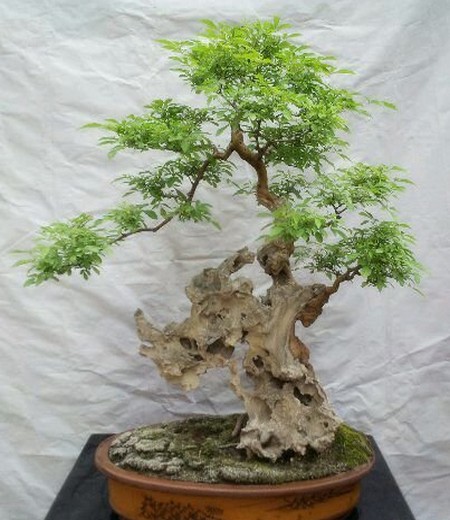
Old Vitex negundo stumps are very ancient-looking, with natural deadwood trunks and hard ossified surfaces that are especially eye-catching, but their shortcomings are long internodes and large leaves. In order to maximize strengths and avoid weaknesses, in terms of styling we need to start from the following aspects:
1. Wiring and pruning
The author's styling principle for Vitex negundo bonsai is coarse wiring and fine pruning. Before wiring and pruning, based on the different forms of the stumps, decide on the design, cut off all useless branches (overlapping branches, crossing branches, front-facing branches, whorled branches, etc.), and wire the retained branches according to their different growth directions. When wiring, pay attention to two points:
First, do not wait until the branches and trunk have grown too thick before wiring; Vitex negundo branches and trunks that are too thick are brittle and easily broken;
Second, when wiring, do not knock off the buds, otherwise in the future there will be missing branches and few leaves, forming a "smooth trunk." After the branches are wired, let them grow and thicken. After one to two years, when the thickness of the branches is coordinated with the main trunk, keep one or two branch nodes and make the first cut. The secondary branches and tertiary branches cultivated afterward should gradually vary in thickness and transition naturally.
2. Reducing leaves
In order to reduce the leaves of Vitex negundo, three methods can be used:
(1) Leaf removal. Generally carried out in early summer, early autumn, or before an exhibition. When removing leaves, do not leave a single leaf (be careful not to remove the leaf buds at the base of the petioles). After leaf removal, appropriately strengthen fertilizer and water management. There is no need to shade; after about half a month, new leaves will emerge, and the new leaves are only one-half the size of the original leaves.
(2) Pinching
Pinching means removing the new buds on the main branches and trunk. During the growing season of Vitex negundo bonsai, it is necessary to frequently pinch and remove the growing tips.
(3) Controlling fertilizer and water
The so-called fertilizer control means that a finished Vitex negundo bonsai, before an exhibition or during the viewing period, is given only water, not "soup." At the same time, watering should also be controlled, allowing the potting soil to be half wet and half dry, preferably on the dry side.
Vitex negundo bonsai has relatively few pests and diseases. Occasionally there are aphids causing damage, which can be killed with dichlorvos solution.