How to prune a potted kumquat bonsai? A detailed guide to the method
Potted kumquats differ considerably from garden-planted kumquats in cultivation methods, and their pruning methods also have their own characteristics. After March, most of the kumquat's fruit falls off naturally; remove the remaining fruit by hand to save nutrients, and at the same time thin out overly dense branches, crossing branches, some leggy branches and branches inside the canopy that receive no light. Carry out heavy heading-back on the retained 1-year-old branches, leaving 2 to 3 buds per branch, with the bud at the cut facing outward, so as to open up the canopy and allow ventilation and light penetration.
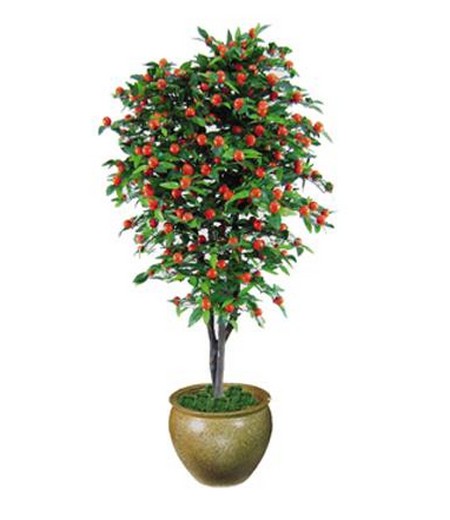
During the flowering and fruiting period, pay attention to thinning flowers and fruit: keep the early-opening flowers and remove late and weak flowers. Generally, flowers opening in May to June have a higher fruit-setting rate and should mostly be retained. Flowers and fruit after July should be removed.
(1) Basic pruning methods for potted kumquats: the basic pruning methods also use heading back, bud removal and thinning. Heading back is used to solve the problems of indistinct main branches, a weak framework and a messy canopy caused by its natural growth. The leaves of potted kumquats live only 1 to 1.5 years, shorter than the 1.5 to 3 years of garden-planted kumquats; heading back can continuously stimulate new shoots and maintain a certain number of new leaves, so as to avoid the interior of old branches becoming hollow and bare. New shoots send out many crowded branches at their tips; heading back the crowded tip branches can make the branches sturdy and the canopy compact and rounded, and makes it less likely for branches to droop.
By heavily heading back weak trees and weak branches and lightly pruning strong trees and strong branches, "suppressing the strong and supporting the weak", the tree vigor can be adjusted. By heading back (cutting) and retaining buds, shoots can be trained in a directed and positioned way, serving to fill gaps in the canopy.
The degree of heading back is divided into heavy heading back and light heading back. Heading back before bud break in spring can build the framework branches and promote the growth of relatively strong shoots. Sometimes, in order to develop sturdy main branches, heavy pruning can be done back to the previous year's or the year before's wood. Light tip heading back removes only a few nodes from the tip of the shoot, and is mainly used to invigorate the current year's new shoots.
Bud removal should be carried out as early as possible; if shoots have already sprouted and the branches have grown too long, take care to protect the compound buds at the base so as not to affect sprouting. Thinning is used to thin out dense branches; cutting away dead and diseased branches keeps the distribution of branches and shoots in the canopy reasonable and even. Thinning is also used to deal with leggy branches, so as to balance tree vigor.
(2) Pruning techniques: there are pruning at the seedling stage and pruning of fruiting trees.
1. Pruning at the seedling stage: this is to build framework branches so as to form a canopy. After the first flush of a grafted seedling matures, cut back hard leaving about 10 cm, to develop main branches. After the main branches mature, prune again before new shoots sprout, to promote new shoot growth. Along with pruning, strengthen fertilizer and water management, and strive to produce multiple flushes of shoots in the same year. The last autumn flush should be made to sprout evenly. After pruning, it can bear fruit in the second or third year.
2. Pruning of fruiting trees: from spring to autumn, shoots at each stage can continuously send out fruiting branches from the leaf axils, that is, in the same year they can grow fruiting mother branches, form flower buds in the same year, and flower and fruit in the same year. To make potted kumquats ripen their fruit during the Spring Festival for fruit appreciation, they must be made to send out summer shoots from late May to early June and form flower buds, then flower and fruit in the same year.
To make the summer shoots sprout in a timely and even manner, pruning is usually required 3 times. The first time, before the spring shoots sprout, head back on the secondary and tertiary branches, cutting back to leave 10 to 20 cm, to promote the growth of large numbers of sturdy spring shoots. Pruning should be done between Yushui and Jingzhe. The second pruning is about 60 days after the first flush sprouts, that is, when the spring shoots have basically matured, cutting back to leave 15 to 20 cm. The third pruning is about 50 days after the second branch pruning, lightly cutting back the tips of the second flush, to promote even sprouting of summer and autumn shoots and thus expand the canopy.