How to propagate potted calla lilies? Detailed propagation techniques
Colored calla lilies are now usually sold as high-end potted flowers, either as single pots or in combination plantings. If the technical issues are resolved, colored calla lilies still have some room for development in the small potted plant market in the future. The advantage of Jinzhou bulbs is that they are multi-flowering and highly disease-resistant, making them quite suitable for producing small potted products with a pot diameter of 12 cm to 14 cm. For example, “California Red”, “Lipstick”, and “California Sunshine” can all be produced as small potted products, with 3 months as one production cycle, which fits the fast-production, fast-sales rhythm of small potted plants, so the future market potential of colored calla lilies is still relatively large. The following introduces its propagation techniques:
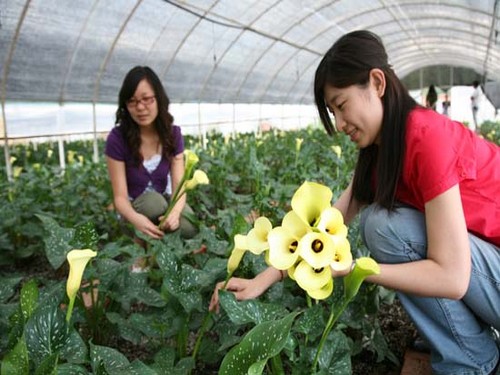
Division:
After the main flowering period or after the dormancy period, dig out the tubers of vigorous clustered mother plants. According to the size of the original tubers and the number of buds, cut one cluster into 2-3 clusters (each cluster should carry 2-3 buds), plant them separately, and with normal management, they can bloom in 3 months.
Bulblets:
Dig out the tubers during the dormancy period. After normal division, some smaller tubers can also be cut off. These small tubers must be cultivated in the open field for 1-2 years before they can become flowering bulbs. Before the ground freezes in autumn, prepare the land and make beds, and use ordinary garden soil to cultivate the bulblets. Bulblets grow slowly; if a culture substrate is used instead, most bulblets can form flowering bulbs in the same year. The culture substrate consists of 1 part perlite (or coarse sand), 1 part leaf mold, and 1 part peat.
In addition, when planting bulblets, every 100 sq m of culture bed should be applied with 10 Kg of diammonium phosphate and 1 Kg of ferrous sulfate. Either raised beds or low beds are acceptable. In early spring, after the soil thaws, plant the bulbs as early as possible. For bulblets larger than 1 cm, the planting density is 10 cm×10 cm, and the depth is 5 cm. Bulblets smaller than 1 cm can be broadcast, with a density of about 5 cm×5 cm, and a soil covering depth of 2-3 cm. After planting, irrigate promptly to ensure sufficient water supply. When the plants enter the vigorous growth period, apply chemical fertilizer every 10-15 d, prepared as a 0.5% aqueous solution with a complete fertilizer of nitrogen, phosphorus, and potassium at 1:1:1.
Bulblets also have the habit of high-temperature dormancy. During the dormancy period, water and fertilizer supply should be reduced or even stopped. A shade net with a shading rate of 30%-50% can also be used to lower the temperature, or coverings such as pine needles and broadleaf tree fallen leaves can be used to lower the soil temperature, ensuring a longer growing season, which is beneficial for the bulblets to grow larger. If flower stems appear during the growing period, they should be removed as early as possible so that nutrients are concentrated for tuber growth. By autumn or the hottest period of midsummer, when the aboveground parts dry up, lift the bulbs, grade them, and store them.
Tissue culture:
The explants used in calla lily tissue culture propagation are young leaves and tubers with buds. Culture conditions: light intensity 1000-1500 lx, photoperiod 12-16 h, temperature 15-25℃. Induction medium: MS+BA1mg/L+NAA0.1mg/L. Subculture medium: MS+BA5-10mg/L+NAA0.2-0.5mg/L. Rooting medium: 1/2MS+IBA1-2mg/L. When the roots of tissue-cultured plantlets grow to 1-2 cm, open the bottle mouth and harden the plantlets for 2-3 d, then pot them. The substrate is a 1:1 mixture of fully sterilized perlite and peat soil. Then place the pots under a plastic tunnel to maintain humidity (relative humidity 90%-100%) and warmth (temperature about 20℃). After 7 d, remove the covering and carry out normal care. In about 1 year, the young plants can bloom.
Sowing:
Calla lilies can be propagated by sowing, but because the natural seed-setting rate is relatively low and seeds are not easy to collect, if propagating by sowing, vigorous mother plants can be selected and retained, and artificial supplementary pollination can be carried out. Seeds can be collected once mature. Sow immediately after collection. The suitable germination temperature is about 20℃, and young shoots emerge in about 4 weeks. Transplant when there are 2-3 true leaves. Under excellent cultivation and management conditions, they can be grown into flowering bulbs in two years.