Detailed Explanation of Crape Myrtle Bonsai Propagation Methods and Techniques
Every flower blooms in its own beauty, each leading its own charm. Take the crape myrtle (Lagerstroemia indica), for instance: it avoids the spring when a hundred flowers contend in beauty, and chooses to bloom at the turn of summer and autumn. Its tree form is elegant, its branches and trunk are twisted and bent, and its flower colors are gorgeous, making it well worth admiring.
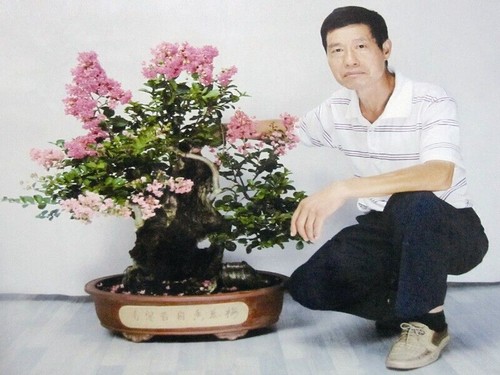
There are many kinds of crape myrtle, with varied postures. Because it is easy to manage, its branches are soft, and grafts or simple bindings heal easily, it can be shaped into various forms according to individual needs: some are gnarled and interlaced, some are light and graceful; some with straight trunks, high branching points and drooping branches are selected as street trees; some extremely short dwarf varieties are used as border plants for landscapes such as flower borders, roadsides and flower beds; those with creeping branches are good for forming large areas of color blocks and can be used where large patches of landscape color are needed.
Crape myrtle also has the characteristics of fine leaves and dense branches, thick trunks and exposed roots, and is easy to train and bend, so it is suitable as material for bonsai and stump scenery; some old stumps are excellent material for bonsai. Crape myrtle flowers can also be cut as cut flowers, and they last longer in a vase than other flowers. The myriad forms of crape myrtle not only adorn human gardens but also bring people visual and psychological enjoyment.
1. Selection and Breeding of Crape Myrtle Bonsai Stumps
Because the original sources of crape myrtle are extremely rich, and there are many varieties of crape myrtle with smooth, ruddy trunks that are quaint, natural and vigorous, they are generally quite common in Central China. If they are used to make bonsai, there are mainly three major shortcomings: first, the branches grow too long and are difficult to control; second, the leaves are too large; third, the flowers are small, the flower shape is not beautiful, and the flower color is not vivid. In late autumn and early winter, relatively thick and large crape myrtles of various types that meet the basic conditions for bonsai can be selected for variety improvement through grafting and variety replacement.
This method is simple and easy to carry out, with a particularly high survival rate, and it fully brings into play the ever-changing, thick and quaint natural charm that these crape myrtles have formed in the wild through nature's uncanny workmanship. The crape myrtle bonsai in the pictures posted on this blog were cultivated through grafting. At the same time, crape myrtle varieties that meet bonsai conditions can also be selected to make bonsai directly or to undergo grafting and variety replacement. Its characteristic is to make full use of the thick, curved stumps of the original species and the elegant tree posture and plant shape; after grafting and combining modern superior varieties, the tree form is compact, the branches are short, the leaves are small, and the flower colors are vivid and beautiful, shaped like rosy clouds, graceful and full of flowers, with a well-arranged high-and-low order, making it pleasing to the eye.
2. Seedling Cultivation
Select crape myrtle horticultural varieties with short and dense internodes, small leaves, easy flowering, vivid flower color, long flowering period and extremely strong adaptability for seedling cultivation, and carry out binding, pruning and shaping according to bonsai shaping techniques.
3. Grafting and Variety Replacement:
Crape myrtle has a well-developed root system, and after root cutting it is extremely easy for new roots to grow, so it is easy to survive when potted. After obtaining a relatively ideal crape myrtle stump, you should first cut and prune it according to the needs of bonsai shaping. If the stump has a good root system, it can be potted and planted directly to cultivate relatively thick branches, which is beneficial for graft survival.
Grafting time: It is generally customary to carry out grafting before spring budding. In fact, different grafting methods can be used, and grafting can be done in all four seasons. According to the graft survival situation, multiple supplementary grafts can be made. The general survival rate is about 98%.