What are the propagation methods for crape myrtle bonsai? This article will teach you
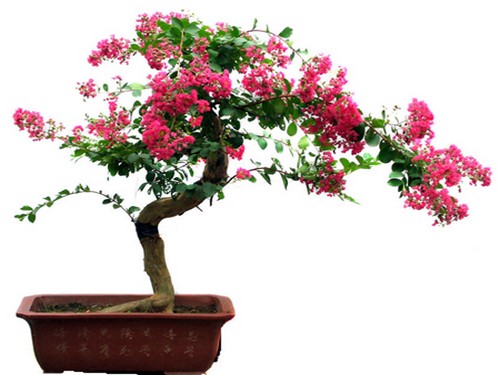
The crape myrtle (Lagerstroemia indica) has a graceful tree form, smooth trunks, brilliant flowers and an exceptionally long blooming period; its flowering can span summer into autumn for more than a hundred days. It is an excellent ornamental, suitable both for beautifying courtyards, parks and green spaces, and for growing in pots for display. Crape myrtle likes sunlight, tolerates slight shade, is drought-tolerant but dislikes waterlogging, tolerates pruning well, and has strong suckering ability. It also grows well on calcareous soil and has fairly strong cold resistance. Crape myrtle can be propagated by sowing, cuttings, layering, division and grafting.
1. Sowing method:
Collect ripe seeds from November to December, dry them and bury them in sand in a cool place to overwinter. Sow from late February to early March, in wide drills or by broadcasting, cover with a layer of fine burnt mud ash just until the seeds are no longer visible, then cover with grass. They sprout and emerge in just over 10 days; remove the grass promptly, and when the seedlings have 2 pairs of true leaves, thin them after rain; weed diligently during the seedling stage, apply diluted fertilizer 2-3 times in June-July, irrigate to prevent drought as summer comes on. By the end of the year the seedlings are about 40-50 cm tall; vigorous ones may flower the same year, and these flowers should be removed promptly. Transplant and grow them on the following spring at the Spring Equinox.
2. Propagation by cuttings:
① Hardwood cuttings: before spring bud break, collect one-year-old branches and cut them into cuttings about 15 cm long, insert them into a loose, well-drained sandy loam seedbed, inserting 2/3 of the way in, water thoroughly, and enclose them with a film arch tunnel. Once the young plants reach 15-20 cm, the film can be lifted and replaced with a shade net, watering as needed; the branches can grow to about 60-80 cm in the same year.
② Softwood cuttings: can be done from early June to early-to-mid September, when new growth is vigorous and at its most vital. Take one-year-old strong branches about 15 cm long, insert them into the seedbed to a depth of 2/3, water thoroughly, and at this time protect them with both a shade net and a film arch tunnel. After about 50 days, remove the film, keep the shade net, and water as needed; the branches can grow to about 60-80 cm in the same year, with a very good survival rate.
There are commonly two types: sexual propagation and asexual propagation:
1. Sexual propagation: seeds generally harvested from September to November are sown the following spring in February-March, with a germination rate above 95%. The seed germination temperature is 15°C to 25°C; after sowing, cover with about 2 mm of soil and cover with film to keep warm and moist.
2. Asexual propagation: divided into propagation methods such as cuttings, division and grafting.
Propagation by cuttings: there are two kinds, spring hardwood cuttings and summer softwood cuttings.
A. Hardwood cuttings: in spring, choose healthy, pest- and disease-free 1-2 year old branches and take cuttings before bud break. Choose a sheltered, sunny spot for the cutting bed, or use pots; generally the cuttings are 10-15 cm long and inserted 8-12 cm into the soil. After cutting, water thoroughly, cover with film to keep warm and moist; after two months they can sprout and root, with a survival rate of about 98%.
B. Softwood cuttings: from May to July, when the branches are semi-lignified, cuttings can be taken in a sand bed or in pots. Cut semi-lignified current-year branches about 5-8 cm long, keeping 2 leaves on top. Make a furrow at a row spacing of 10 cm, with a plant spacing of 2 cm, insert 4/5 into the soil, water thoroughly after inserting, then cover with film and a shade net to cool and retain moisture. Depending on the weather, spray water on the branches or water the sand bed to prevent the cutting medium from drying out and the branches from lacking water. They root in about half a month, with a survival rate above 95%.
C. Propagation by division: because crape myrtle has strong suckering ability at the roots, many small shoots readily grow from its base. From after leaf fall in winter to before bud break in spring, use a sharp tool to cut and separate them, then transplant the small shoots with some roots elsewhere to grow.