Detailed explanation of branch-pad styling methods for Chinese ash bonsai
Chinese ash (Fraxinus hupehensis) is a fast-growing species with vigorous growth. After one year of training and pruning of the trunk and primary branches, apart from a few terminal transition branches, cascading branches and drooping branches deliberately left long to thicken, most branches can be pruned and built into pads in the second year.
In the early stage, primary and secondary branches are mainly wired (or guyed), with pruning as a supplement; in the later stage, once the branch pads have basically taken shape, pruning becomes the main method with guy-wiring as a supplement. Generally, the pruning technique of "upper first, lower later" and "suppress the strong, support the weak" is adopted for trimming.
Upper first, lower later: that is, prune the upper part of the tree first, then after some time prune the middle branches, and after several more days prune the lower branches. On the same branch pad, prune the upward-growing branches first, and wait until the parallel and downward-growing branches have grown thicker than the upper branches before pruning them.
Suppress the strong, support the weak: strong vigorous branches in the upper part should be pruned several days earlier, and when the weak branches have grown to a certain thickness, prune them in turn. The aim is to make the thickness of the branches match the position they occupy.
For trees with particularly vigorous growth, besides paying attention to control at ordinary times, leaf removal and pruning can be carried out to build branch pads.
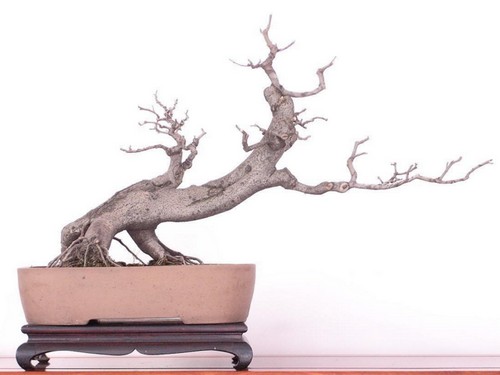
After the autumn frost, the leaves wither after frost and the branch structure is exposed, which is very favorable for observing the line and direction of the branches (pads), their front-to-back interweaving, their rise and fall, and their position and form. At this time, a careful round of pruning and wiring can be carried out on the branch forms. What can be pruned into place is done by pruning; what cannot be pruned into place can be bent and pulled into place by wrapping with aluminum wire; if some branch pads are too upright or their direction and position are not ideal, pull them into place with aluminum wire or rope.
For Chinese ash, special attention should be paid to its opposite buds and frog-leg branches; when selecting branches on the trunk and on the primary and secondary branches, remove opposite branches in a staggered manner; frog-leg branches can be grown long on one side while being shortened on the other, or changed into a dropped-crook branch.