How to Propagate Carnations from Cuttings? Detailed Cutting Methods and Steps
Carnation propagation is divided into two types: asexual propagation and sexual propagation. Sexual propagation often has a low seed-setting rate, and the offspring grown from seed show great variation in traits and slow seedling growth, so it is rarely used in production. In production, asexual propagation is widely used, mainly cutting propagation, which has the advantages of abundant cuttings, stable traits and quick results.
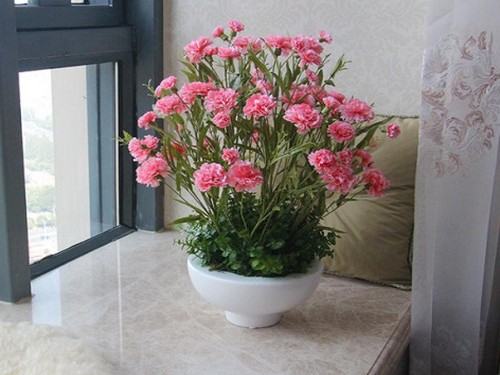
Carnations are most suitable for cutting propagation. There is no restriction on the timing of cuttings; apart from the overly hot season, propagation can be done in any other season. Among these, cuttings taken in early February have the highest survival rate. For cuttings, choose mother plants with excellent varieties, robust growth, uniform flowering, few nodes, good quality and no pests or diseases, and peel off (preferably not with scissors) their well-developed side shoots 6 to 10 cm long as cuttings. When peeling, remove them together with the leaves, but be careful not to damage the mother plant.
If cuttings are taken in winter, the cuttings must be kept warm, and this can be done in a greenhouse or a plastic film shed. The seedbed soil must be loose sandy soil rich in humus. Before cutting, plow the ground once; it is best to first move part of the soil out of the shed to dry in the sun for two days, then mix in 1/3 rice-hull ash and coarse sand to make the soil loose. If the weather is clear, remove the plastic film and expose the soil to the sun for 3-4 days for disinfection, which is more reliable. Water the soil to moisten it one day before cutting; when cutting the next day, the soil will be just moderately dry and moist.
When cutting, rinse the cuttings with water, insert them to a depth of about 2 to 3 cm, with both plant spacing and row spacing of 5-6 cm. Water immediately after inserting, and cover for shade (do not water again for the next 10 days; water again when the surface soil turns white, and avoid excessive moisture that causes root rot). Keep the temperature at 10°C-20°C; roots will form in about 20-25 days, and transplanting can be done in about 45 days.
When transplanting, gently lift the seedlings together with the root soil and plant them into the seedbed, damaging the roots as little as possible, and water after planting. Apply a liquid fertilizer once after 10 days, and again after another 10 days. When the seedlings grow to 12 cm, they can be planted in their final position. After 20 days of final planting, carry out the first pinching; when the plant height is 30 cm, set up a net support to keep the flower stems upright. Generally, only one flower is kept at the top. Fertilize once a week during the growing period. When the flower buds show color, cut them; cut flowers should be brought to market promptly and stored fresh in a low-temperature environment of about 4°C.
Carnations are most suitable for cutting propagation. There is no restriction on the timing of cuttings; apart from overly hot weather, propagation can be done in any other season. Among these, cuttings taken in early February have the highest survival rate. Below, the editor will introduce the cutting methods for carnations!
1. Establishment of the stock plant garden for cutting collection. Practice has proved that the stock plants for cutting collection must meet the following conditions: the plants are relatively young in age, have good flowering traits, have a disease index of zero, and the part from which cuttings are taken must be strictly controlled above the 6th node. Therefore, establishing a dedicated stock plant garden for cutting collection is very necessary and crucial, and it is also an indispensable link in the modern carnation seedling production process. It is both the prerequisite for forming high-quality seedlings and the foundation for year-round large-scale seedling cultivation.
The stock plants in the stock plant garden for cutting collection must be tissue-cultured seedlings. The key to cultivation and management in the stock plant garden is: strengthen soil disinfection, advocate crop rotation, ensure sufficient base fertilizer, must have rain-sheltering and shade measures, advocate drip irrigation, and do a good job in pest and disease control.
2. Cutting techniques
(1) Selection of cuttings. Choose plants that are free of pests and diseases, grow robustly and have closely spaced nodes, with 3--4 pairs of unfolded leaves and 1 pair of unopened leaves, and with a flower bud rate of less than 10% in the group of cuttings.
(2) Cutting time. Generally, avoid the hot summer months of July--August. The cuttings are required to be of good quality, use larger-particle perlite as the cutting medium, have good water quality, and use a raised bench as the cutting bed.
(3) Taking and inserting cuttings. The taking of cuttings is generally carried out at the same time as bud thinning of carnations. Cuttings should be taken according to standards; when taking cuttings, pinch off the shoots by hand rather than cutting with scissors, so as to avoid cross-infection by viruses. The base should carry a little cortex of the main stem, but must not damage the mother branch, and 4--5 leaves at the top of the cutting should be retained while the rest are removed. After sorting into bundles, soak them in clean water for 30 minutes so the cuttings absorb enough water. The cut surface should be close to the node and treated with growth regulators to improve the survival rate and the rate of seedlings leaving the nursery. When inserting, insert about 1 cm into the medium. In summer, insert deeper, generally 1.5-2 cm. After cutting, spray enough water, and afterward control moisture so it is not too wet, to avoid root rot.
(4) Storage of cuttings. Storing cuttings can greatly facilitate year-round seedling cultivation and balanced year-round flower supply, and can also allow batch operations at one time, saving manpower and material resources. Storage requirements: temperature 1--2°C, and the smaller the fluctuation the better, preferably within ±1°C; undergo slight dehydration treatment before storage; cuttings should be packaged in ultra-thin plastic film.
(5) Cutting management. The cutting bed should have intermittent misting facilities, with the misting amount controlled so that the leaves are just moist. If there is no misting measure, plastic film must be covered, and after 1 week change to reed curtains, but do not shade too much, to prevent leggy growth. When the roots of the cutting seedlings are 1 cm long, transplant them, taking care to damage the roots as little as possible.