Detailed Guide to Winter Jasmine Propagation Techniques: Common Methods and Key Points
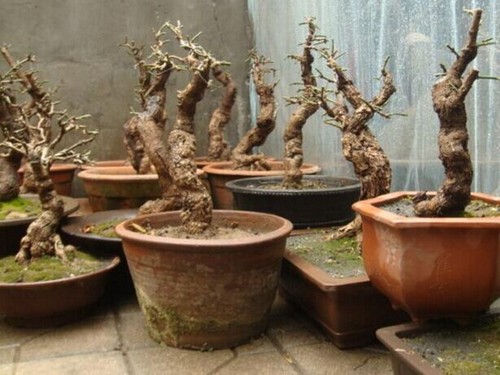
Winter jasmine (Jasminum nudiflorum) grows rapidly and is very suitable for making bonsai. Select a thick, sturdy old winter jasmine stump, plant it in a cylindrical pot, expose the roots and claws, bind it moderately, and let the trunk droop; within just a few years, an elegant and graceful cascade-style bonsai can be formed. Alternatively, select a small stump about the thickness of a thumb, wrap the lateral roots around a rock, and bury it in soil to create a form with exposed hanging roots and claws; within one or two years, a fine and compact palm-sized bonsai can be made, appearing delicate and elegant, and placed indoors or on a desk for great charm. So, how do you propagate such a beautiful winter jasmine?
1. Division propagation method
If division propagation is used, choose to do it in spring or autumn. The method is to cut the small branches growing from the roots and stem base of the winter jasmine at the point where they connect to the mother plant, then plant them separately. After planting, water with some settling water to improve the survival rate. Generally, a perennial mother plant can be divided into 10~20 small clumps, and they can bloom after planting. Winter jasmine can be divided in both spring and autumn, but dividing in spring when the buds have just begun to swell is best; each clump can be divided into 20 small clumps, and they are very easy to keep alive.
2. Layering propagation method
Similar to division propagation, in layering propagation the plant also produces roots. When layering is used, winter jasmine has a high survival rate, is easy to manage, and the young plants grow vigorously. However, the number propagated is relatively low. The method is to bend a 1~2-year-old branch of the mother plant near the ground downward and press it into a dug pit; the pit does not need to be very deep, 3~5 cm is enough, then cover with soil and firm it, and water some to keep the soil moist and improve the survival rate. Layering generally takes about 2 months to root, and after it survives, it is separated from the mother plant and transplanted in the spring of the following year.
Hardwood branches are often layered around March and root in June; softwood branches are layered in May and can root 30 days after layering. If watered regularly, they root even faster. When layering winter jasmine, no cutting or wounding treatment is needed. A small wooden stick can be placed upright at the base of the layer and tied with string to make it grow upward. After one year of layering, it can be separated from the mother plant.
3. Cutting propagation method
The most commonly used method for winter jasmine is cutting propagation, because the survival rate of cutting propagation is higher than that of division propagation and layering propagation. Cutting propagation is generally carried out in July and August each year. Before cutting, first prepare a seedbed area: prepare a seedbed 2.5 m wide and 10 m long, filled with 12 cm of sand. Before cutting, simply rake the seedbed once with an iron rake to expose the moist sand on the surface. Because the weather is hot, a sunshade net must also be placed over the seedbed to regulate temperature. Then select 1~2-year-old winter jasmine branches, preferably robust, full, pest-free and disease-free branches.
Cut the selected branches into small sections 10~15 cm long, cutting flat about 1 cm above the upper axillary bud and cutting flat about 1 cm below the lower axillary bud. Before cutting, first dip these cut branches in rooting water. The rooting water is made by mixing 20% active-ingredient naphthaleneacetic acid powder with water; adjust the ratio properly: one packet of naphthaleneacetic acid powder is 5 g, and adding 500 mL of water is enough. Dipping in rooting water is to supplement the exogenous auxin needed for plant rooting, and it can also promote the synthesis of endogenous auxin in the plant, thereby promoting the rapid formation of adventitious roots in the cuttings.
After winter jasmine finishes blooming in February, cut 15 cm-long branches and insert them into the soil, with the buried portion accounting for about one half of the branch, and remove the leaves. The aboveground part may have leaves or not, but keeping some leaves makes rooting easier. After one month, they can root.