How to propagate Kalanchoe blossfeldiana by cuttings? Master these techniques for a high survival rate
For home propagation, Kalanchoe blossfeldiana is mainly grown from cuttings. Rooting speed varies with the season and temperature; whether you take tip cuttings, stem cuttings, or leaf cuttings, the survival rate varies depending on which part is used.
Kalanchoe blossfeldiana can be propagated by cuttings all year round. Cuttings take best at an air temperature of 20-25°C with humid air. They root easily and survive well, forming a root system in just over 10 to over 20 days, and can be transplanted after just over 30 days. In the hot, stuffy summer they are prone to root and stem rot, so after planting avoid direct sun and use diffused light, keeping the medium moist and the air moving; after planting in winter, increase sun exposure or use supplemental lighting, as rooting slows when the temperature is below 15°C; below 10°C growth stalls, so it is not a good time to take cuttings.
Every part of Kalanchoe blossfeldiana can be used for cuttings. From top to bottom, the lower down the part, the harder it is to root; new growth and tip cuttings of the year root fastest and survive easily; stem sections are next; the lower, already woody stems are hard to root and the hardest to get to survive.
Shoot-tip cuttings: it is best to use a sharp knife to cut off a 6-8cm shoot tip of the current year's new growth, keeping 4-5 pairs of leaves. Once the wound has dried, insert it about 1cm into the prepared medium; inserting too deep easily causes stem rot. After planting, water thoroughly once, then simply keep the medium moist day to day. After planting in winter, supplemental lighting is needed. Rooting speed varies from fast to slow depending on the variety.
The quality of the cuttings determines the future appearance of the plant: to ensure the fine characteristics of Kalanchoe blossfeldiana, choose robust plants with a graceful shape, free of pests and diseases, with tender green, thick leaves and brilliant flower colors as mother plants for propagation, so as to grow even better-quality Kalanchoe blossfeldiana the following year.
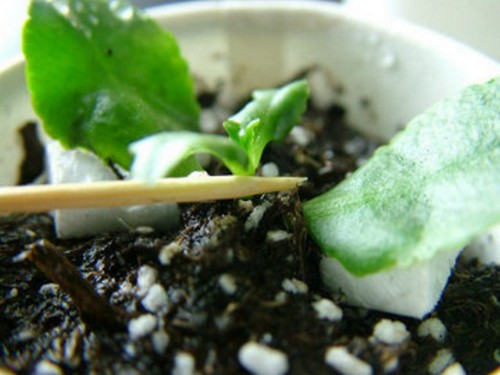
Leaf cuttings: the leaves of Kalanchoe blossfeldiana can also be used for cuttings, but they sprout very slowly, generally taking about half a year. When taking leaf cuttings, choose larger, thicker leaves and cut them off at the base with a sharp knife. After leaving the whole leaf in a cool place for the wound to dry for several hours, insert the petiole into moist medium. If the petiole is too short, you can also insert part of the leaf instead of the short petiole, at an angle or straight into the medium. Keep the medium moist; too wet easily causes the leaves to become diseased and rot. After planting, place them in a spot with slightly weaker sunlight.
My own cutting propagation is done once a year in spring after the flowers fade, combined with repotting and shaping, when I prune and take cuttings all at once. In day-to-day care, whenever shaping requires it, I take cuttings from the pruned branches at any time. The growing medium used for propagating Kalanchoe blossfeldiana by cuttings is based on peat, perlite and vermiculite, in a ratio of 3:2:1. To prepare it, mix it evenly, cover it tightly with plastic sheeting, and it is ready to use after fermenting for 48 hours.
Leaf cuttings: remove the whole leaf (the bigger the leaf, the better), leave it in a cool place for the wound to dry, and after several hours insert the petiole completely into moist medium. If the petiole is too short, you can also insert part of the leaf into the medium in place of the short petiole. At this stage it must not be too wet, to avoid the leaf becoming diseased and rotting. After planting, place it in a spot with slightly weaker sunlight, keeping the temperature between 20-25°C.
After 3-4 weeks the root system begins to establish, at which point it can be placed under full sun and given low-concentration fertilizer. After another 7-10 weeks, young seedlings differentiated from callus tissue become visible. When the seedlings grow to 15-20cm, they can be separated from the leaf and grown on their own, while the leaf can continue to produce seedlings. The separated seedlings can be used as mother plants to produce unrooted cuttings.
Tip cuttings: insert the prepared unrooted cutting directly into a pot filled with medium, keep the medium moist, avoid overly strong light, and maintain a temperature between 20-25°C; roots will form in about 2-3 weeks, after which the plant can enter production-stage management. Tip cuttings are generally used mostly for potted-flower production. (Note: Kalanchoe blossfeldiana is a typical long-day plant for flowering, so during cutting propagation the day length must be longer than 12.5 hours, and supplemental lighting must be used when propagating by cuttings in winter.)
Kalanchoe blossfeldiana is mostly propagated vegetatively; besides cuttings, tissue culture is also widely used for propagation.
Cuttings can be divided into two methods:
Leaf cuttings and tip-shoot cuttings. Generally, leaf cuttings and tissue culture are mostly used for producing mother plants; tip-shoot cuttings are mostly used for potted-flower production. In potted-flower production, unrooted cuttings are usually inserted directly into the pot in which they will finally be grown, so the growing medium and the cutting medium are the same: peat and perlite mixed in a 7:3 ratio, with the medium's pH adjusted to between 5.5-6.0. Producers can adjust the ratio according to their own water quality, the varieties grown and the production season, or add vermiculite, sand and other soilless media, to achieve a medium that drains well and contains moderate nutrients.