Detailed Explanation of Bonsai Wiring and Shaping Techniques for Camellia
Camellia is one of the top ten famous flowers in China. With its characteristics of remaining evergreen through winter, braving frost and snow, and blooming in the cold, it adorns gardens in winter and early spring. If used for bonsai, its elegant and dignified plant form, glossy green leaves, and the natural combined effect of beautiful yet not gaudy flowers can make indoor spaces shine and brim with vitality.
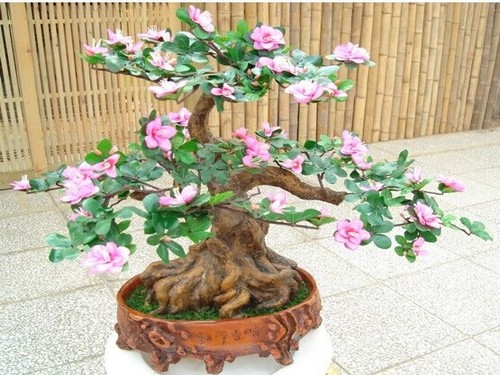
The creation of camellia bonsai wins through "artistic conception." Through human conceptual design, camellia bonsai involves clever artistic treatment of the trunk stance, apex formation, and root exposure of natural-style camellia seedlings, thereby expressing a feeling of expansiveness, boldness, and elegance.
When using camellia seedlings to create bonsai, one should select camellia seedlings with an upright and posture, a full and abundant form, an intact tree shape, a trunk and branches resistant to bending, and basically clear layering. The trunk should be treated first, then the branches and apex, and finally the root exposure treatment.
The trunk is treated into shapes such as the curved-trunk style. During creation, according to the growth tendency of the seedling material, decisive pruning and shaping artistic measures are adopted. When treating branches, the main branches that serve a supporting role should be left on the trunk.
Apex formation is the main part that expresses dynamism and should be given special attention. During branch treatment, the tree shape must be well-balanced, with appropriate lightness and emphasis, and reasonable lengths. Throughout the layout of the entire stump bonsai, one should persist in highlighting artistic measures of mutual harmony such as density and sparseness, emptiness and solidity, exposure and concealment, echo and response, hardness and softness, cleverness and simplicity, and thickness and thinness.
Camellia potting and shaping generally use the cliff-hanging style and the rolling-branch style. For the cliff-hanging style, pots such as Yixing tall-footed cylindrical pots or tall cylindrical tub pots can be used. For the rolling-branch style, proportionally balanced round pots or square pots can be used.
Camellias used for bonsai wiring should all be planted at an angle when potted, so as to facilitate the manipulation of the trunk posture. Generally, the trunk is first coiled into a posture favorable for branch wiring. Commonly used postures include the drop-crook and the rolling-dragon-embracing-pillar crook. When coiling the trunk, the side branches, fine branches, and leaves of the camellia should generally all be retained. After the trunk is formed, the side branches are then processed. The wiring method for side branches can be determined according to the characteristics of the area that the branch should occupy, respectively using upright bends, slanting bends, and irregular recurved bends, to the extent of filling the gaps on the surface of the crown. All the above wiring is done with palm fiber using double-strand tying.
Wiring operations should be carried out after potting, once the new branches have hardened, which is about one month after potting. Because camellia wood is relatively hard, like that of osmanthus and golden ball, during each bend operation one should carefully "knead the branch," that is, first knead and bend each small section of the branch segment involved in that bend. After bending in both forward and reverse directions, the bark and phloem of the branch and trunk are made to adapt to external forces through extension and compression, and the xylem through squeezing and stretching. Only then can the palm fiber be tied well to fix the shape. Otherwise, after shaping is completed, the plant's branches and trunk may break due to increased sap flow.
Finally, through the wiring of small branches, the leaf surface of each leaf is made to face outward. Because the tree species used for rolling-branch shaping are all flowering trees and shrubs that bear flowers in the leaf axils (camellia, osmanthus, plum blossom, wintersweet, elm-leaved spirea, etc.), the effect after shaping is that flowers can bloom all over a spherical or inverted-ovoid plant crown, displaying magnificence and nobility. Therefore, the process of wiring small branches and turning leaves should be carried out even more meticulously.
In order to make the alternately arranged camellia leaves on the branches all turn their surfaces outward, when coiling small branches one should carefully knead and twist them, so that they neither break nor fail to achieve the leaf-turning effect. After the operation is completed, only then can individual redundant branches and leaves that cannot be dealt with be pruned away. If some gaps during wiring need to be filled by young shoots, this can only be done after the young shoots have aged and hardened.