Detailed Explanation of Styling Methods for Syzygium buxifolium Bonsai Stock Material
Syzygium buxifolium (boxleaf syzygium) has become an excellent tree species for making bonsai because of its advantages: dense branches, small leaves, year-round green foliage, peculiar and grotesque trunk shapes, a thousand forms and a hundred postures, interlacing branches, interesting gnarled root bases, wide adaptability, and easy management. However, a perfect Syzygium buxifolium bonsai must also rely on artificial artistic processing, carrying out trimming and styling, so that the bonsai does not grow tall or grow wild, and its form becomes even more perfect.
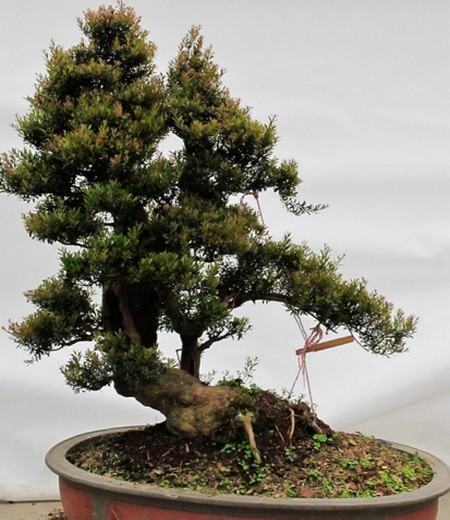
1. After new buds sprout, remove the moss or rice straw wrapped around the old trunk and branches to cover them, so as not to affect bud growth. At this time the new roots have not yet grown well, so water management must be strengthened: spray water frequently on the tree stump, branches and leaves to reduce water evaporation from the leaf surface. When the new buds grow to 3cm-4cm, bud thinning should be carried out, removing buds in unsuitable positions and overly dense buds to ensure that the buds left behind grow strong. Bud thinning can be done in 2-3 rounds; at the first bud thinning, spare buds should be kept to guard against accidental damage. After the buds sprout for 2-3 months, the root system gradually grows well, and the plant can be moved to a place with 1—2 hours of sunlight each day (excluding 11 a.m. to 3 p.m.), watered once each morning and evening (except on rainy days), and sprayed frequently on the tree stump, branches and leaves. The root system of a newly planted tree stump is young and tender, so never apply concentrated fertilizer; it is better to apply thin fertilizer frequently.
2. After the collected (or purchased) Syzygium buxifolium tree stump has been cultivated until September, cut off the surplus branches and trunks, and shorten the long branches to stimulate the growth of lateral buds below the cut, prompting the tree stump to produce 2—3 flushes of branches in a year, so as to increase the number of branching orders and shorten the distance between each order of branches, enabling the tree stump to take shape as early as possible and take on an ancient posture. After the tree stump has taken shape, in order to maintain its graceful styling, excess and overly dense branches need to be cut away; doing so also helps balance nutrient supply and enables the Syzygium buxifolium tree stump to grow normally.
3. After the tree stump planted in spring has survived, branch thinning and fixing of branch pads can be carried out after Mid-Autumn, gradually increasing the proportion of fertilizer and water. Syzygium buxifolium has a high rate of new bud sprouting, with latent buds all over the whole plant, making it very convenient to choose and decide on the positions of bonsai branches. Let the required branch pads grow freely until after the Beginning of Spring the following year before pruning, but the flowers of the current year must be removed to avoid consuming nutrients.
4. The shaping and wiring of the Syzygium buxifolium tree stump is carried out after September. Depending on the thickness of the branches, choose suitable metal wire (the bark of Syzygium buxifolium is rather thin and easily injured; before binding the metal wire, first wrap paper around the outside of the metal wire to avoid injuring the bark) or coir fiber (palm rope). If the bending arc is relatively large, it should be done in 2—3 stages to prevent the branches from breaking or being injured too severely and dying. Wrap moss, cloth or wet rice straw, etc. around the bending point of the branch, and afterward spray water frequently on the bending point so that the wound there (the injured tissue) heals as early as possible and normally transports nutrients and water, etc. In addition, a newly planted Syzygium buxifolium tree stump should not be wired too early; it must be done after it has completely survived, so as to avoid blocking the flow of sap and causing death.
5. Because Syzygium buxifolium roots quickly, produces many roots and long roots, the best time to pot it is after the Beginning of Spring in the second year after planting. Lift the tree stump out without pruning the new roots; it is better if a little soil can be brought along with it, and replant it in a display pot. Because Syzygium buxifolium fears dryness, the pot used should be somewhat deeper and somewhat larger. When potting Syzygium buxifolium, it should be heavily pruned once. To increase the density of lateral angular branches, heavy pruning should be done twice each year in spring and summer, and all unwanted new buds on the whole stump should be removed; in this way Syzygium buxifolium can sprout twice a year, speeding up the shaping process. During the growth of Syzygium buxifolium, the branches are brittle and easily broken, which is unfavorable for wiring; in the cultivation process, the trunk-chopping and branch-cultivating method should be adopted, mainly using pruning and rarely using wiring.