Detailed Explanation of the Key Styling Techniques for Chinese Sweet Plum (Sageretia thea) Bonsai
Sageretia thea, also known as duijieci, sageretia vine, sour fruit, and sour-berry tree, is a deciduous climbing shrub of the genus Sageretia in the family Rhamnaceae. Its roots and trunk are naturally peculiar, and its tree form is vigorous and antique, making it one of the main tree species for stump bonsai in China. Sageretia thea is a major bonsai tree species of the Lingnan school and the Su school, and is also commonly used in other regions. It is one of the five famous trees in Lingnan bonsai, and is also one of the bonsai plants exported to the United States.
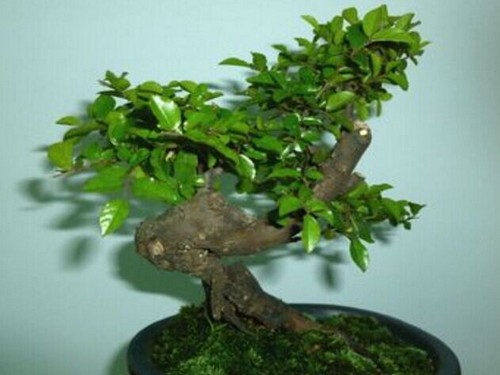
Sageretia thea is the finest among stump bonsai, possessing an upright and unyielding character, strong sprouting ability, good adaptability, vigorous vitality, and ever-changing appearances through the four seasons with a thousand forms and appearances. It is suitable for making into various styles of bonsai and has very high ornamental value. So how should a Sageretia thea bonsai be styled to look good?
Freshly collected Sageretia thea stumps must be properly pruned. If they are wild Sageretia thea, they need a certain period of cultivation to build up branches before they can be processed and styled.
1. After the stumps are collected and transported back, according to the size of the pot and the physiological habits of the stump, carry out appropriate trimming. Use 0.3%-0.5% potassium permanganate or 500-800 times diluted solutions of carbendazim, green copper, thiophanate-methyl, etc. to apply to the branch and trunk wounds or soak the tree roots, then plant them in the nursery bed and water thoroughly. Wrap moss or green grass on the old stumps and branches and trunks, apply white latex or vegetable oil to the branch and trunk wounds, and then seal and bind the large wounds with plastic film.
2. After new buds sprout, remove the moss or green grass wrapped around the old stumps and branches and trunks so as not to affect bud growth. At this time, the underground part has not yet rooted, so a shade shed must be set up and water management strengthened to reduce water evaporation from the leaf surface and prevent tender buds from being sunburned. When the buds grow to 1-2 cm, remove some unsuitable and overly dense buds to ensure that the remaining buds grow robustly. Bud removal can be carried out in 3-4 rounds.
3. After the collected Sageretia thea stumps have completely survived (that is, after being cultivated until September-October of the second year), repeatedly observe and study according to the characteristics of the tree form, conceive the styling, and then process it.
4. Preliminary processing. After the Sageretia thea stumps have completely survived, under conditions of appropriately less water and less fertilizer, transplant them multiple times with soil to make the root system contract, and at the same time further prune the roots and branches to form the framework of the bonsai. Attention should be paid to giving full play to their natural beauty and preserving the ridges, wrinkles, ruggedness, and aged peculiarity on the branches and trunks. For multi-trunk specimens, consider changes in height, size, distance, and density, as well as the echoing relationships between front and back and left and right. At the same time, trunks and main branches that need bending processing can be worked on during this period. After preliminary processing, the Sageretia thea stumps can be planted in pots after another 1-2 years of cultivation, and further detailed processing can be done later. Potting is best done before sprouting in spring.
5. Detailed processing. According to the conceived design for the Sageretia thea bonsai, use the following 3 steps for artistic processing.
Pruning: Cut short the overly long branches and trunks of Sageretia thea to promote the sprouting and growth of lateral buds below the cut, which can make the Sageretia thea stumps send out 2-4 flushes of shoots in one year. This can increase the number of branching orders and shorten the distance between each order of branches, so that the stumps take shape as early as possible. Later, on the basis of maintaining their graceful styling, cut off excessive and overly dense branches so that the Sageretia thea stumps grow normally.
Binding: According to the thickness of the Sageretia thea branches, choose suitable iron wire, steel wire, or aluminum wire, wrap it with a layer of paper or cloth strips, and wind it around the branches in the adjusted direction to bend them. Palm fiber or palm rope can also be used for binding. After bending the branches and trunks, tie them firmly with palm fiber or palm rope. Note that whether metal wire or palm fiber is used for binding, it must be loosened once every 3-4 months to avoid the wire, etc. sinking into the bark after the branches thicken, which would affect the tree's growth and appearance.
Root exposure: To cultivate a Sageretia thea bonsai with exposed roots, place it in a deeper pot or in the nursery bed, with fertile soil in the lower layer and sandy soil in the upper layer, so that new roots grow into the fertile soil. After a period of time, remove part of the sandy soil and move it into a selected shallow pot, making the roots suspended and the stems exposed, vigorous and powerful.