Detailed Guide to Pinching and Topping Techniques for Bonsai and Flowering Plants
Pinching means using your fingers to nip off (or cut off) the growing tip of the main stem or side branch of a flowering plant, to encourage axillary buds to sprout or to suppress leggy branch growth, so the plant grows sturdy and attractive with more flowers.
For common herbaceous flowers, such as scarlet sage, snapdragon, five-color pepper, and Madagascar periwinkle, once the seedlings have established after planting and the plant height is about 10 cm, you can top them to encourage more branching and more flowers. Similarly, for wax begonia, fuchsia, and chrysanthemum, after the young seedlings have established, they should be pinched to encourage more side branches, a fuller plant shape, and an increased number of flowers.
However, for some flowers that become smaller or fail to bloom after pinching, such as garden balsam, cockscomb, and Jiangxi aster, pinching is not advisable. Some woody flowering plants are usually topped and pinched in spring when repotting or when the main branches are growing vigorously, to speed up the formation of branches. For example, pomegranate, Chinese rose, plum blossom, poinsettia, bougainvillea, and night-blooming jasmine can be topped multiple times according to the cultivation purpose and the plant's growth vigor.
For the climbing morning glory, I generally pinch the main vine the first time when it has grown seven to eight leaves. After the axillary buds appear, keep only the two buds toward the lower middle and remove all the rest. Then, the second time, wait until four to five leaves have grown and pinch while keeping only two leaves. When leaf buds grow again, choose three good buds to keep and remove the rest! Personal opinion, for reference only!
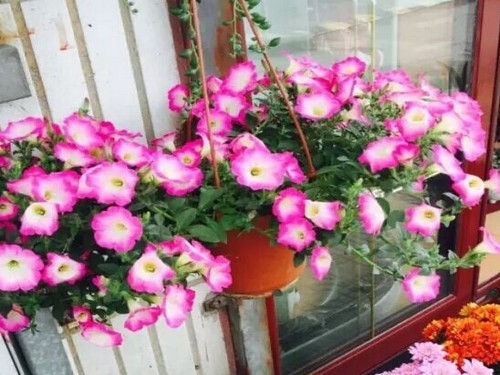
The photo above of pinching petunias makes pinching clear at a glance; fellow gardeners can draw inferences from it and need not stick rigidly to an identical approach. The biggest factor in getting petunias to spill over the pot is topping: removing apical dominance encourages side branches to sprout, and the more side branches there are, the more mainstays of blooming there will be. The first pinch and topping is generally done when the seedlings have 6 true leaves; after that, each time a side branch grows to 6 leaves, top it once, nipping off 2 leaves and leaving 4 leaves, referred to as "pinch 2, keep 4." A pot of compact, trailing petunias then begins to take shape.
Some woody flowering plants are usually topped and pinched in spring when repotting or when the main branches are growing vigorously, to speed up the formation of branches. For example, pomegranate, Chinese rose, gardenia, plum blossom, and poinsettia can be topped multiple times according to the cultivation purpose and the plant's growth vigor.