A Detailed Guide to Bonsai Pinching Techniques: Methods and Key Operation Points
Pinching, also known as topping, refers to removing the terminal bud of the shoot tip on a plant's main stem or lateral branch. It can remove the plant's apical dominance, inhibit the growth of the main branch, encourage the plant to produce more lateral branches, promote dwarfing of the plant, enrich the plant's form, and increase the sites and number of flowers. Pinching can also adjust the plant's vegetative growth, delay the flowering period, or promote a second bloom. In the growth process of herbaceous flowers and woody plants, pinching techniques are often used.
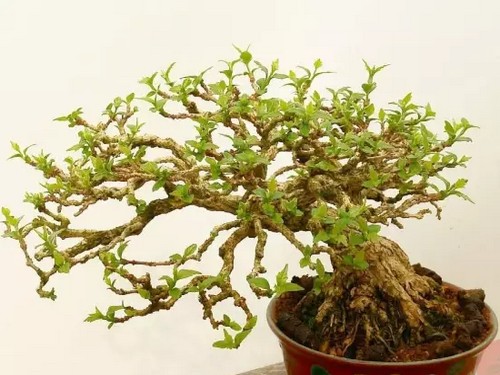
Pinching is the work of treating reserved main branches, basic branches, or lateral branches. Pinching is determined according to the cultivation purpose and method, as well as the variety's growth type and other aspects. When the reserved main stem, basic branches, or lateral branches grow to a certain number of fruit clusters and number of leaves (length), their terminal growing points are removed (main stems with self-terminating growth do not need pinching). Pinching can control height increase and elongating growth, and is beneficial for thickening growth and accelerating fruit development.
For general herbaceous flowers, such as scarlet sage, five-color pepper, Madagascar periwinkle, zinnia, moss rose, cosmos, and so on, after the seedlings are transplanted and have survived, when the plant height is about 10 cm, topping can be carried out to encourage more branching and more flowering. For example, for wax begonia, Kalanchoe blossfeldiana, fuchsia, chrysanthemum, and so on, after the small seedlings are transplanted and have survived, pinching should be carried out to encourage more lateral branches, a fuller plant form, and an increased number of flowers. However, for some flowers whose flowers become smaller or fail to bloom after pinching, such as garden balsam and cockscomb, pinching is not suitable.
Pinching of fruiting branches should be carried out 30-40 days before vine removal, that is, only flower buds about 40 days before vine removal are effective. For pinching lateral branches retained as auxiliary nutrient branches, the standard is not to affect light between plants and to reach the planned number of retained leaves.
Pinching should be carried out in the morning. If it is a fruiting branch, then 2-3 leaves should be retained before the frontmost 1 inflorescence, which is beneficial for fruit growth and can also prevent the fruit from being directly exposed to sunlight and causing sunscald.
After pinching, lateral branches will grow vigorously, so pruning of shoots and pinching of lateral branches should be strengthened; otherwise, normal fruiting will be affected.
Pinching has two effects:
First, it promotes branching and increases the amount of branches and leaves, and can also moderate the growth vigor of young trees, avoiding "rampant water sprouts";
Second, it can promote the formation of axillary flower buds in trees in full fruit-bearing stage.
The above two effects are different, and the pinching time is also different. For the first, the pinching time is when the new shoot grows to semi-lignified, generally carried out from late May to mid-June, removing about 1/3 of the new shoot, and at the same time removing 1-3 leaves at the front end of the branch after pinching, so as to facilitate bud sprouting.
Pinching should not be too early or too late, because if pinched too early, often only one bud sprouts at the tip, and it still runs as a single shoot, failing to achieve the purpose of promoting branching; if pinched too late, the new shoot is already close to the terminal growth stage, the sprouting ability is weaker, and the branches that grow are also not ideal.
For the second pinching time, it should be grasped 7--10 days before the new shoot reaches terminal growth, because if earlier it promotes branch sprouting, and if later its effect on forming axillary flower buds is not great. This effect is mainly applied to trees in full fruit-bearing stage, and basically has no such effect on young trees.
Bonsai bud pinching operation completed
The bud tips that were pinched off