Detailed Explanation of Bonsai Pruning Techniques: Prune This Way for a More Beautiful Tree Shape
Bonsai pruning is synonymous with the means of shaping potted trees. Although there are also techniques such as wiring, pulling and hanging, guying, carving, and grafting, they are often conventionally grouped under "pruning." As the main means of bonsai styling, it not only incorporates related techniques but also embodies styling concepts and compositional creativity within the "cut."
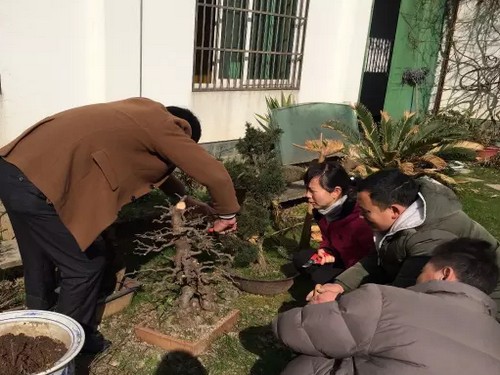
Yet on a little reflection, what matters is not pruning itself, but the styling principles and related common knowledge expressed through pruning. For pruning itself is nothing more than a 45-degree diagonal cut, requiring the cut surface to be flat, clean, and neat; as for rough pruning, fine pruning, and precision pruning, these are merely different stages in the process of shaping and pruning a potted tree. Therefore, what matters is the skill beyond the cut, namely "how to prune," and questions of what to "remove" and what to "keep." In view of this, there are two points to ponder and examine in detail: the plant characteristics and the aesthetic characteristics of potted trees.
The three-prune, three-do-not-prune principles of bonsai pruning:
1. Prune late, not early. It is generally believed that winter, when trees stop growing, is the best time to prune branches, and that one should emphasize "winter pruning." This view is not entirely comprehensive. To be precise, some tree species can be pruned in winter. For example, after short pruning in winter, crape myrtle branches may look withered, but once spring arrives, new buds will grow on the short branches.
But there are two situations that will cause winter pruning to fail:
First, the tree species is unsuitable. Take the elm, for example: once its branches have wounds, they easily lose water. So after winter pruning an elm, the shortened branches will dry out from water loss during the long, dry winter.
Second, branches that are too thin are unsuitable. Regardless of the tree species, winter pruning of branches that are too thin will inevitably cause the branches to die.
In fact, "spring pruning" is better than "winter pruning." Pruning branches in early spring before the trees bud: at this time the air temperature is a little higher, and new buds will sprout within a relatively short time, so there is no risk of branches drying out. Compared with "winter pruning," "spring pruning" has no other disadvantages either. For trees that bloom in spring, such as azaleas and plum blossoms, pruning must be done even later, after the flowers have finished, otherwise removing the flowering branches would defeat the purpose.
2. Prune thick, not thin. Some people, pursuing rapid formation of a bonsai, impatiently short-prune new branches that have not yet become woody, hoping to grow side branches that same year and then prune again, pruning two or three times in a year to quickly form several levels of branch pads. The author did this in the past, and the result was contrary to expectations:
First, for some tree species, pruning branches before they become woody does not produce side branches; instead, buds sprout from the cut and continue growing forward, failing to form an angle, as with Chinese holly.
Second, forcibly pruning branches into pads will cause the work to lose its momentum. For tree species such as privet and water willow, young branches can produce side branches after pruning. But this should not be done either. Short-pruning branches into pads necessarily presupposes a set length for the branch pads, assuming that after the work takes shape the length of the branch pads will not change greatly. But if the branches forming the pad are thin and tender, they will continue to grow relatively quickly. As a result, the length of several levels of branch pads will greatly exceed the intended length, making the proportions look unbalanced. The entire tree's momentum becomes slender and thin, and it cannot be remedied.
Practice has proven that the correct approach is to wait until the branches have become woody and have roughly grown to the intended thickness before pruning. In this way, the side branches that grow will inevitably form a better angle. One must overcome impatience: branches intended as branch pads must be allowed to grow to the intended thickness, generally at least one year of growth, and if not thick enough, another year without hesitation.
3. Prune fat, not thin. After short-pruning a branch, if the branch pad does not sprout new buds for a long time, and even if it does sprout, the side branches do not grow vigorously, this is due to a lack of fertilizer. To prompt branch pads to quickly produce strong buds and grow new branches rapidly, the amount of fertilizer applied should be as much as possible on the premise of not causing "fertilizer burn." During the peak growing season, you can alternate watering once and fertilizing once. But be careful not to make it too concentrated. Done this way, during the growing season with suitable temperatures, the side branches should grow continuously.
Finally, it must be explained that the "three prunes, three do-not-prunes" are aimed at unformed bonsai. If the bonsai work has already taken shape, pruning branches is to maintain the tree shape, to prevent the bonsai from growing too large and wild, which is a different matter.
Regarding the common methods for pruning bonsai plants, Qiliang has summarized some effective methods for everyone's reference:
1. Pinching
To inhibit the growth of a tree bonsai and promote the development of side branches, the tender tip of its branches can be pinched off.
2. Bud removal
When many adventitious buds grow at the base of or on the trunk of a tree bonsai, they should be removed in time to avoid forked branches sprouting and ruining the beauty of the tree shape. For example, the magpie tree is very prone to producing adventitious buds, so one needs to be watchful about bud removal.
3. Leaf removal
For foliage bonsai, the viewing period is often when new leaves sprout. For example, by removing new branches from pomegranate, the tree can be made to send out new leaves several times a year, bright and eye-catching, enhancing its ornamental value. For tree bonsai such as maple and ginkgo, the effect of viewing can also be increased by leaf removal.
4. Branch pruning
Tree bonsai often grow many new branches. To maintain a beautiful shape, attention must be paid to regular branch pruning. The method of branch pruning should be determined according to the tree shape; if it is a wave-like shape, then the branches are pruned into an undulating form. Generally, parallel branches, dead branches, crossing branches, and the like that detract from the appearance should all be pruned away in time.
5. Root pruning
Root pruning is generally carried out at the same time as repotting. Roots that are too overgrown or too dense should be pruned. This can be considered according to the following situations: if the tree's new roots are poorly developed and the roots have not densely filled the bottom, then when repotting, a slightly larger pot should be used, dense roots thinned out, old roots removed, and a few new roots kept for repotting. When repotting, some old stump bonsai can have their roots appropriately raised to increase the ornamental effect, and old roots and root tip portions trimmed away, then grown in loose, fertile soil to encourage new roots.