How to shape a wintersweet bonsai? A detailed guide to practical methods
In Yanling, Henan, the "hometown of wintersweet," traditional wintersweet bonsai forms include single-trunk plum, dragon plum, knot plum, single-hanging-branch plum, double-hanging-branch plum, round-hanging-branch plum, screen-fan plum, and pearl upside-down roller blind, among others. It can be shaped by training and wiring young trees, or by using old, rugged dog-tooth wintersweet stumps as rootstock, grafting excellent varieties such as pure-hearted wintersweet and qingkou wintersweet onto them; its roots swell and become knot-like, which is called "knot plum."
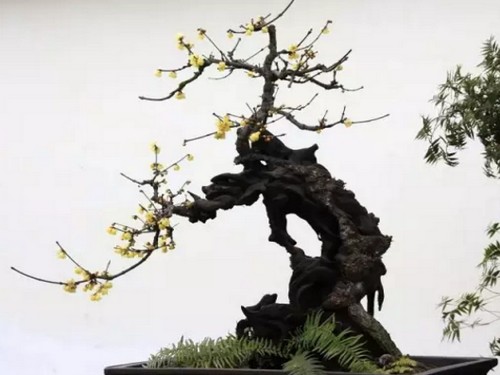
Because wintersweet branches are rather brittle and break easily, they are not suitable for large-scale bending and shaping. Generally, coir rope is used only to slightly hang, tie, and twist the trunk or large branches, and then the fine branches are lightly pruned. This is generally done from May to August, because at this time the branches are soft. Before operating, pay attention to controlling watering to further soften the branches and make shaping easier.
In Yanling, there is another traditional technique for making wintersweet bonsai, the "knife method," generally carried out from March to April. The method is to make an oblique cut downward from top to bottom toward the center of the trunk with a knife at the part of the wintersweet trunk that needs bending at a certain distance from the potting soil, with a depth of about 2/3 of the trunk diameter. Then gently bend the trunk by hand at the place below the cut, but do not break it. Use the tip of the opened triangular xylem to press against the opposite slanted surface, and insert a small stone or broken tile piece into the opened gap to prevent it from returning to its original position. After applying mud to the cut, wrap it with plastic sheeting, and then fix it to a support pole. For thicker trunks, a saw can be used to make an oblique cut. This "knife method" can make an upright trunk form a bend with a certain angularity, and this method can also be used to shape thicker branches.
This "knife method" can be used alternately on both sides of the trunk at intervals to make it bend and pitch; it can also be used in rotation to make the trunk sway left and right, increasing the sense of movement. Nowadays, the cuts are mostly made according to the tree shape and the intended design. Wintersweet bonsai shaped with the "knife method" have characteristics such as distinctly angular trunk and branches and an overall vigorous and powerful tree form.
When making wintersweet bonsai, you can refer to the images of wintersweet and plum blossom in Chinese painting, and according to shaping needs, place scholar's rocks at suitable positions on the pot surface to increase the antique, elegant, and unusual charm of the bonsai, making it more full of poetic and pictorial beauty.
To make wintersweet bonsai, you can choose a purple clay pot with good permeability for planting. The shape of the flower pot can be selected according to the specific form of the tree stump and the different styles of the bonsai. Because its flowers are wax-yellow, it is advisable to choose flower pots in dark colors such as reddish brown, dark blue, and dark green to create contrast, and it is not advisable to choose light yellow pots. Although glazed porcelain pots are beautiful, they have poor permeability and can easily cause root rot in wintersweet, resulting in poor growth or even death of the plant, so they can be used as cachepots.
For a formed wintersweet bonsai, carry out a timely pruning and shaping after the flowers fade, cutting off part of the perennial branches to encourage the branches to sprout small lateral branches again. Depending on the tree shape, aged branches can also be heavily pruned to facilitate renewal and rejuvenation, but pay attention to the position and direction of the terminal buds on the retained branches. During the growing season, pay attention to pinching the new tender branches of the current year to encourage more branching, and to change the direction of the branches, making the branches grow thick and strong, produce more flower buds, and bloom more.
During the growing season, for some new branches of the current year that need bending, hemp rope or coir rope can be used to pull them appropriately, and necessary pruning should be carried out according to the tree's nature and growth vigor. After autumn begins, when the flower buds grow to the size of a grain of rice, carry out a pruning and shaping to control excessive branch growth, make the plant compact, and achieve the artistic effect of sparse shadows slanting across, and to help the plant accumulate nutrients so that its flowers are large and brightly colored.
To make wintersweet flourish with branches and flowers year after year, pruning and bud pinching are extremely important. Pruning is generally done from March to June, and stopped after August. After flowering each year, the old flowering branches should be shortened immediately, with each branch retaining only 15-20 cm at most. After the new branches grow 2-3 pairs of buds, pinch off the terminal buds. Soon side branches will grow again. After they grow to 10 cm, pinch the buds again. Repeat this several times until the flower buds are basically formed. Also thin out and prune various crossing branches, parallel branches, overlapping branches, opposite branches, leggy branches, and excessively dense or weak branches that affect the beauty of the tree shape. There is a saying in flower lore that "wintersweet is not short of branches," so wintersweet can be heavily pruned.