How to shape wintersweet bonsai? Detailed explanation of methods and principles
There are many ways to shape wintersweet bonsai. Taking the Sichuan-style bonsai as an example, they make wintersweet bonsai mostly in the “rolling dragon style,” whose characteristic is a momentum like dragons flying and phoenixes dancing. If wintersweet is to keep a tree form, shape it after new branches grow; if making a stump landscape, cut off the upright branches and shape it after new branches emerge the following year.
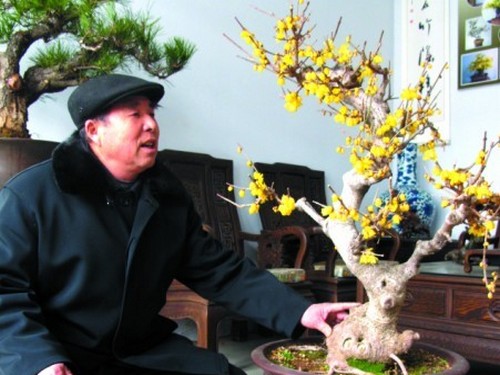
A common shaping style for wintersweet bonsai is also the “natural style,” whose characteristics are clear layers, a prominent trunk and a distinct character. The method is to use its upright branches, which can also be trained into corridor frames, fences and other shapes. Stump landscapes are mostly grown and shaped in the ground; after potting, later care and management are strict, adhering to the fertilizer and water principle of “apply frequently and lightly, water only after the soil dries out.” It is a patient, meticulous and long-term care and management task.
The shaping of wintersweet bonsai is mainly based on pruning, and the following four principles should be followed when shaping:
1. The concept must be clear, and suitable raw materials should be chosen according to the theme.
2. Pruning must have a clear purpose: decisively cut off diseased, damaged and surplus branches. Prune little in the first year, aiming to cultivate branches and strengthen the root system (strong roots make strong branches), and wait until new branches have grown in the second year before pruning according to their growth.
3. Wintersweet is a plant grown for both flowers and foliage, and it values many branches and many flowers, so extensive pruning should be avoided.
4. The roots should be coiled and the claws exposed. There are mainly two methods for exposing the roots. The first is artificial digging of the roots, which is fast but easily damages the roots; the second is washing with water, which requires repeated washing, does not easily damage the roots, but is slower.
Wintersweet readily sends up suckers, so root suckers and branch buds that affect the shape should be removed at any time. In spring, after wintersweet unfolds two pairs of leaves, begin pinching combined with shaping; after the new buds unfold leaves, pinch again. Generally, pinching can be done 2 to 4 times.
1. Cutting and bending branches with a knife. This shaping design is made according to the habits of wintersweet, whose branches are brittle, heal quickly at wounds, break easily and are not easy to wire. It can generally be done during the growing season, but it is best when the buds have just begun to swell and have not yet unfolded leaves. When cutting with a knife, hold it at a 45° angle to the longitudinal axis of the branch, with a depth reaching up to two-thirds of the diameter. Generally, according to the size of the bending angle, a small angle can be shallow and a large angle can be deep, to the extent that the branch is not broken but the required shape is achieved. After bending, it can be fixed with wire, and the cut can be wrapped with plastic tape, which can be removed only after the cut has healed.
2. Wiring. When done during the growing season, it can be done after cutting and bending branches with a knife, or after withholding water. Generally, after wiring with iron wire, the required form is achieved gradually.
3. Pruning. This is generally done at the end of the flowering period, combined with branch shaping. Cut off branches that do not match the shaping of the main branches, making a slanted 45° cut 0.5-1cm in front of a leaf axil. Special attention should be paid to the direction of the buds in the leaf axils.
4. Pinching. This is an important shaping method. Generally, when there are 2 to 3 pairs of leaves, pinching can be done, and when necessary, even one pair of leaves is enough. Pinching can be done 2 to 4 times a year, so that the main branches take shape quickly.
There are about 4 ways to shape the branches and trunk:
(1) Upward-extending branch style, also called antler style. The main branch's branches and small branches mainly bend downward and then grow upward, increasing from few to many. The form is relatively natural, and shaping mainly relies on pruning and pinching.
(2) Horizontal branch style. The main branch and branches grow nearly horizontally, and the small branches may point slightly upward. It is shaped by a combination of wiring, pruning and pinching.
(3) Weeping branch style. The main branch is curved, and the branches and small branches all point downward. It is mainly shaped by wiring and cutting and bending branches with a knife.
(4) Coiled style. The main branch and branches all have relatively large curves, and the small branches may be curved or straight. It can be shaped by wiring and bending branches, or by pruning and pinching, giving people a sense of antiquity, novelty and beauty.