How to shape a pine bonsai in the tall-trunk weeping-branch style? Detailed practical tips
When we walk into the Wenzhou Bonsai Garden on Jiangxin Island, we are soon amazed and filled with admiration by the bonsai of varied shapes, fresh and graceful composition, and scenery that balances movement and stillness. Especially those “tall-trunk weeping-branch style” pine bonsai, revealing the great in the small, fully displaying the uprightness and vigour of the pine. The “tall-trunk weeping-branch style” pine shaping is the forte of Chinese bonsai art master Hu Leguo; because it is extremely rich in poetic and pictorial charm, it is much loved by bonsai enthusiasts at home and abroad.
Once the concept of “tall-trunk weeping-branch style” was advocated by Hu Leguo, it immediately won the enthusiastic following of bonsai enthusiasts at home and abroad. Many people believe that, compared with the short and stocky style of Japanese pine bonsai, the “tall-trunk weeping-branch” style, with its elegant and unrestrained air and its bold opening and closing, is the most Chinese; it is rooted in Chinese culture, full of the characteristics of the Chinese nation, and best embodies the stylistic features of Chinese pine bonsai.
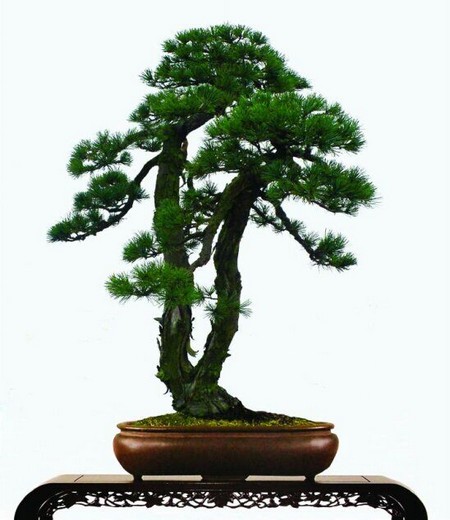
Leafing through bonsai magazines and bonsai monographs, there are indeed many fine pine bonsai, but most are short and stocky, gnarled, and twisted. Tall-trunk ones that express the towering, upright and majestic nature of the pine are truly as rare as morning stars. As an image of tallness and magnificence, the tall-trunk pine seems unfairly neglected by bonsai. The single-minded pursuit of low, stocky and dense forms does not match the appearance of pines in the natural environment, and still less does it suit the character of the pine. Therefore the author conceived the idea of using the tall-trunk pine bonsai in pine bonsai shaping to fully reflect the character of the pine and carry forward the spirit of the pine.
I. Selection of the tree stump
Tall-trunk pine bonsai refers to pine bonsai whose trunk is tall and slender, vertical or slightly curved or slightly slanting. The tall-trunk pine bonsai discussed here is different from literati-style bonsai. Japanese black pine, Japanese red pine and Masson pine are ideal materials for tall-trunk pine bonsai, because their trunks are tall and covered with bark plates, rugged and ancient-looking, with emerald green needles, meeting the shaping requirements.
When selecting this kind of stump material, choose material whose trunk height is below 120cm, with many branches on the upper part, and no need for branches on the lower two-thirds of the trunk. The thickness of the stump and the trunk should be in harmonious proportion; the trunk diameter is generally best controlled at 5cm to 10cm. When selecting stumps, one may also, according to the specific appearance of the stump, choose a stump whose upper branches can, after working, be used as a substitute for the trunk; this is also very good material.
The locations for selecting tall-trunk pine stumps and for selecting other deciduous tree stumps are different. For other deciduous tree stumps, one goes to roadsides, beside cliffs, and places easily reached by people and livestock, where there are many strange and unusual stump materials. For tall-trunk pine stumps, one goes to mountain tops or into the forest to select them. On mountain tops, the altitude is high, the sky is cold and the wind strong, and they are easily attacked by natural disasters such as wind, frost, thunder and lightning, making the overall image of the stump low, with a straight trunk and dense branches, so ideal stump material is easy to find. In pine forests, through the natural survival of the fittest, the strong have grown tall and large while the weak have become thin and small; the small pines caught among the trees are excellent material for bonsai shaping. Even a tall pine, as long as the trunk proportions are harmonious and the branches have grown into place, can have its crown cut off and still be ideal material for bonsai shaping.
As for digging up the stump, in most areas north of the Yangtze River it is generally best from February to May; when digging, bring a soil ball, retain as many fibrous roots as possible, and protect the branch pads from damage.
II. Shaping of the stump
In shaping tall-trunk pine bonsai, one must fully reflect the towering beauty, upright beauty and ancient beauty of the stump, display its clanking iron bones and upright spirit, and express its spirit of strenuous struggle and vigorous upward growth.
For tall-trunk pine bonsai, the branches should not be kept in too great a number; generally 3 to 5 branches are enough. Keeping too many makes it look bulky and lacking in backbone. Branches should be kept on the upper two-thirds of the trunk; keeping them too low fails to show a towering, majestic air. As needed, one should also consider adding “shari” or “jin” as accents to increase the effect.
To reflect a tall-trunk pine that grows vigorously, with an upright trunk and dense needles, one should, when shaping, consider making its needles dense and forming large cloud-pad shapes, and the branches should preferably use the flat-spreading form. To increase the sense of movement, one should make either the left or the right branch stretch out as far as possible while the other side should be “contracted”, striving to show its tall, upright and magnificent side.
The appearance of pines at the summit of high mountains, because they suffer the erosion of a harsh natural environment, has a vertical or slightly slanting trunk, short distances between branches, branches that should droop slightly, and needles forming small cloud-pad shapes and sparse; one should design “shari” or “jin” as accents. Strive to show the side of defying brute force, struggling hard, and possessing tenacious vitality, as in Figure 2. In addition, pines growing in sea of forest rarely visited by people, beside mountain streams, have slightly curved, slightly slanting, quaint trunks; their branches droop, their needles are sparse, and they have “jin”. Their whole bodies are covered with bark plates, and green moss and vines cling to them; seen from afar they are grand and spectacular.