A Detailed Guide to the Correct Fertilization Methods for Pine Bonsai
In the wild, pines mostly grow in barren or high-altitude areas. They are a sun-loving (heliophilous) pioneer tree species, which is to say that pines do not need much fertilizer to grow well. In horticultural cultivation, however, fertilizer is still applied in order to make the trees grow quickly and shorten the cultivation time. This is especially true for us amateur growers, who spare no fertilizer and wish the tree would grow an inch overnight.
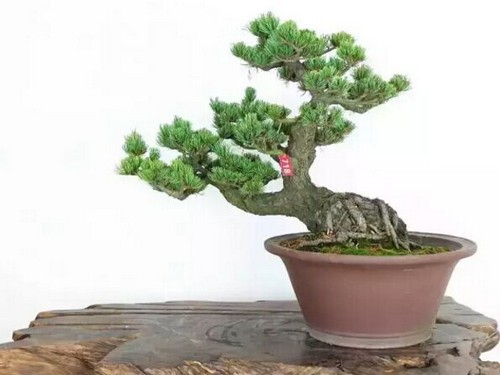
Because bonsai are cultivated within the limited space of a pot and within the soil it contains, organic matter is decomposed by bacteria into inorganic salts, which are then absorbed by the tree's roots. As the pine grows and consumes nutrients, the essential nutrients in the pot gradually decrease, leading to insufficient nutrition and making growth difficult, so nutrients must be replenished regularly. When fertilizing, you must grasp the quality and quantity of fertilizer used during the pine's growth period and storage period, so as to give full play to the fertilizer's effectiveness and meet the pine's growth needs.
Fertilization should vary according to the different tree species, the age of the tree, the size of the pot surface, and the quality and nature of the fertilizer. Fertilization must be determined on the basis of characteristics such as root growth, distribution and absorption, in order to decide which fertilizer to apply. Generally speaking, more fertilizer should be applied during the growth period and the nutrient accumulation period, and less fertilizer should be applied to finished trees and during the dormant period.
The basic principles of fertilization:
The organic fertilizer used must be thoroughly decomposed; raw fertilizer that has not been fermented and decomposed cannot be used. Raw fertilizer that has not been fermented can damage the pine's roots and affect the surrounding environment. Whether applying organic fertilizer or inorganic fertilizer, apply little but often. Fertilization must be timely: for example, if the leaf color turns pale and growth becomes thin and weak, nitrogen fertilizer should be applied immediately. Fertilization should take temperature into account; when the temperature exceeds 25°C, fertilizer should not be applied.
Fertilizers can be divided into natural organic fertilizers and chemically synthesized inorganic fertilizers. Inorganic fertilizers have a high concentration and a stable composition, but long-term use of inorganic fertilizers easily makes the potting soil acidic or alkaline, hindering the pine's growth. The organic fertilizer used must be fully fermented before use. Dilute the original liquid with 10 times the amount of water, then pour it into the potting soil. Those who dislike the smell can add sulfurous acid before watering; besides having a deodorizing effect, it can increase the green color of the leaves and reduce melanin.
1. Spring fertilization:
For trees with weak vigor, fertilizer can be applied a little earlier, around 2 to 3 months after the buds begin to move. Since the tree is weak, you cannot and need not apply too much fertilizer at one time. Pine bonsai are repotted from February to March each year, and fertilization begins in May, applied once every 15 days for three consecutive applications, because this is precisely the pine's growth period. Fertilization stops by mid-June, because the temperature is relatively high at this time and fertilizing easily damages the roots. Pine bonsai should be given more phosphorus and potassium fertilizer and less nitrogen fertilizer.
2. Autumn fertilization:
In late summer and early autumn, around August to September, when the weather begins to turn cool and the pine starts growing rapidly again after its summer dormancy. Generally speaking, autumn fertilizer must be applied; if fertilizer is not absorbed sufficiently in autumn, new shoot growth will be poor the following spring, affecting the tree's growth for the whole year.
In summer the temperature is too high and the sunlight is strong, while in winter the temperature is low and the sunlight is weak, so the pine's growth slows down (cells grown in summer are the same size as, or even larger than, those grown in spring and autumn, so the phenomenon of slow summer growth cannot be seen from the annual rings), and it does not need (too much) fertilizer. Especially under full sun in summer, water evaporates quickly; if too much fertilizer remains in the potting soil, the ion (fertilizer) concentration in the water may rise sharply due to water evaporation, causing fertilizer burn. Even if it does not reach the level of fertilizer burn, the osmotic pressure will reduce the plant's ability to absorb water, diminishing the effect of the pine's particularly important reliance on transpiration to cool down when temperatures are high.
After repotting, it is best to wait 1 to 2 months before fertilizing. If you miss the timing, just wait for the next opportunity; missing one fertilization does not matter much (if the pot was only lifted out without breaking up the soil, fertilizer can be applied one week later in line with the spring and autumn fertilization timing, but it should not be excessive, as that would affect the extension of new roots).
Fertilization begins in early October each year, applied once every 15 days for two consecutive applications, with more phosphorus and potassium fertilizer so as to accumulate nutrients. When fertilizing, pay attention to the following:
(1) The pot surface should not be too dry, because fertilizing when it is too dry easily damages the roots; nor should it be too wet, because when it is too wet the roots cannot absorb the fertilizer and root rot easily occurs.
(2) Fertilization should be done little but often, and the potting soil is most suitable when neither dry nor wet. Nitrogen fertilizer is an important element in forming proteins. If nitrogen fertilizer is insufficient, the leaves turn pale and growth declines; if there is too much nitrogen fertilizer, the stems and leaves become weak and soft. The main role of nitrogen fertilizer is as a leaf fertilizer.
(3) Phosphorus fertilizer can form cells and has a great influence on cell division. It works together with nitrogen and potassium to maximum effect, and insufficient phosphorus causes poor root development. Phosphorus fertilizer is mainly bone meal, and phosphorus fertilizer has the effect of promoting flowering and fruiting.
(4) Potassium fertilizer has a great influence on photosynthesis and can help transport nutrients to the roots and branches, enabling them to extend and function. Potassium can adjust potting soil that is too acidic, and plant ash can also be used to correct acidity in the soil. Potassium fertilizer strengthens the roots, promotes the absorption of ammonia and phosphorus by the potted tree, and makes it robust and tolerant of cold and heat.