Pine Bonsai Styling Techniques: A Guide to Help You Create a Beautiful Tree Form
Every living thing in nature is influenced by other living things, and people intervening in the growth of pine trees through technical means is one expression of this influence. Even today, this phenomenon still exists, and this is the prevalence of potted plants. Pine trees hold a very good meaning in traditional Chinese culture, symbolizing a firm and resolute character, symbolizing longevity and so on, and are therefore deeply loved by people. Precisely because of this, pine bonsai are also greatly favored by people. An elegant antique pot holding a small pine tree, with a few uniquely shaped stones placed beside it, set in a spacious living room, truly elevates the owner's taste.
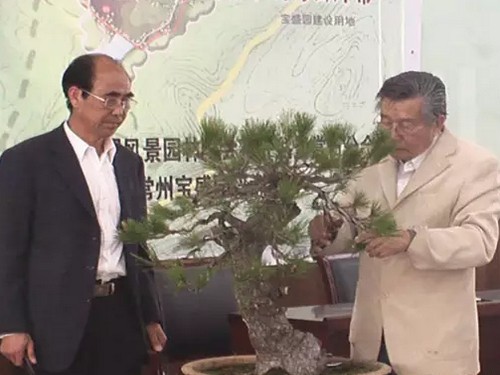
An excellent pine bonsai should possess a beautiful form and superb maintenance and management techniques; neither can be missing. Even if a bonsai master creates the styling, without careful maintenance and management, the tree may wither and die or grow excessively, leaving the original bonsai unrecognizable. A pine pre-bonsai stock can be wired and shaped by a bonsai technician in a very short time, but maintaining and managing it well requires years of hard work and superb management skills.
I. The Complete Process of Bonsai Styling
1. One foundation — a comprehensive foundation in culture and the arts and in bonsai-making techniques.
2. Four stages:
① Creation preparation: potted raw material and tools, soil, pots, etc.
② Conception and composition: from the creative motive to the birth of the image of the future complete work. Conception and composition follow the principle of "adapting to the material." When seeking the "viewing face," note that its requirement is that from the root base to the top of the trunk, its extending posture and development trend play a decisive role. Next are the left and right branches. For example, when creating, note that the trunk should draw in, to form space in front and depth behind: the trunk tip leans forward, to create a friendly, harmonious feel.
③ Processing and fabrication: following the series of bonsai artistic expression techniques, carry out horticultural technical measures such as hanging and wiring, pruning and carving to complete the specific processing and fabrication procedures. Trunk first, then branches; branch styling should proceed from bottom to top, and potting is last.
④ Maintenance and refinement: maintenance is the continuation of tree bonsai styling, the stage of gradual perfection. A bonsai is a living work of art, one that can never be finished.
II. Creative Characteristics of Pine Bonsai
1. Pine bonsai should be created using expression techniques centered on majestic beauty and masculine beauty.
2. The ecological and physiological characteristics of pine trees determine that only the original branches can be used for wiring and styling, to express the natural posture of overlapping branch layers.
3. Pine trees like sunlight and tolerate drought, so soil with good drainage and aeration and shallow purple-clay pots should be used.
III. Time for Transplanting and Styling Pine Bonsai Material
The best time to transplant pine bonsai material into pots: the eighth lunar month to the first ten days of the ninth lunar month, and the first lunar month to the first ten days of the second lunar month.
The best time for styling pine bonsai: the twelfth lunar month to the first ten days of the second lunar month.
IV. Roots, Trunk and Branches Form the Skeletal Structure of the Bonsai Tree
Styling refers to the recombination of the skeletal structure of the material's roots, trunk and branches according to the artistic laws of bonsai beauty, so that it becomes a complete, harmonious, smooth-lined, deeply evocative living bonsai work of art.
The main contents of recombination are: selection and elimination, adjustment, and correction.
1. Trunk treatment
The postures of trees in nature are endlessly varied, mostly because different growing environments cause different changes in the posture of the tree's trunk, so trunk treatment is the key to tree bonsai styling. Although tree trunks in nature take a thousand forms, when reduced to essentials there are only two basic forms: straight trunk and curved trunk. A curved trunk can be a deformed "S" shape, and can further be divided into several bonsai forms, such as slanted-trunk style, curved-trunk style, cascade style, and so on.
Requirements for the tree trunk:
① Whether curved or straight, the trunk is required to taper gradually from bottom to top. If the taper is rapid, a short, stout bonsai can be made; if the taper is slow, a "literati tree" bonsai can be made.
② Except for straight trunks, the trunk line is required to have naturally extended and just-right bending changes.
③ If the material is a multi-trunk clump, in addition to the above two points, attention must also be paid to changes in the height and size of the trunks, and changes in primary versus secondary status and in density and spacing.
Methods for treating the trunk:
① Truncation: in tree bonsai material, from the base of the trunk to the tip, everything is constantly changing, such as the thickness, curvature and straightness of the trunk, the position of branches on the trunk, the texture and color of the bark, and so on. Wherever the upper part of the trunk is judged to lack variation or to be mediocre, cut it off there; if the retained section is judged to be insufficient in height, then for the sake of perfect harmony, the highest-positioned branch should be set up to replace the tip.
② Use simple mechanical means to correct the extending posture of the trunk, so as to make it shorter and sturdier or to make the trunk line more vigorous and vivid. Curvature and straightness are both innate; as long as the trunk line meets the requirements of bonsai beauty and its characteristics are fully brought out, there is a possibility of becoming a fine work.
③ The trunk styling of small bonsai is generally given appropriate bending, to express vigor and sinuous grace.
2. Branch treatment
Branch treatment most concentratedly embodies the specific contents of selection and elimination, adjustment, and correction in bonsai styling.
(1) Selection and elimination of branches: the issues most closely related to branch selection and elimination include the culling of branches, the ideal position of the first branch on the trunk, the length of branches, the density of branches, changes in branch pads, the composition of the crown, the description of the outer contour line of the crown, and so on.
As a general rule, the thickness of a branch should be about 1/4 of the trunk thickness at the point where it emerges. In a vertically oriented composition, branch length should be much shorter than the trunk height; in a horizontally oriented composition, branch length may exceed the trunk height.
The first branch is most ideally located around 1/3 or around 2/3 of the trunk height. Pine bonsai branches should emerge somewhat high, to express their style of loftiness and uprightness, but branches should not emerge around 1/2 of the trunk height.
The spacing between the first branch and the branches above it is the greatest, to set off the main branch. The higher up it goes, the denser the spacing between branches becomes, to give the crown fullness, and care should be taken to prevent the appearance of a "bare neck." In controlling branch selection and elimination, be strict at the lower part and lenient at the upper part.
The first branch is the longest branch on the whole tree, and progressing upward, branches should gradually become thinner and shorter. This forms the crown as a scalene triangle. As for the overall treatment of branches, there are changes of front and back, length and shortness, and density, so that the actual outer edge line of the crown should be a free curve with rises and falls, advances and recesses, rhythm, and a very light musical quality.
Branches to be avoided during styling generally include whorled branches, symmetrical branches, upright branches, inward-facing branches, closely parallel branches, crossing branches, directly front-facing branches, directly rear-facing branches, trunk-cutting branches, and so on. The methods for dealing with these branches are, first, to adjust their direction of extension, and second, to remove them directly.
(2) Adjusting the growth direction of branches. There are up-and-down adjustments and front-and-back adjustments.
The growth direction of tree branches in nature varies with tree species, tree age and growing environment, and when summarized, generally takes the following different forms: upward-extending, horizontally spreading, drooping, and radiating.
The branches of pine and cypress bonsai should use the horizontally spreading and drooping forms, and the angle of horizontal spreading or drooping of branches is generally between 45° and 90°. On the same tree, the angle formed by branches and trunk should generally be kept consistent and should not be changed at will. For deciduous broadleaf trees, it varies with the tree and can be appropriately relaxed, allowing for a bit more "variety."
There is a range for front-and-back adjustment of branches; generally, only adjustments of no great angle on a single plane are appropriate, so that branches have the beauty of natural extension and simple elegance.
(3) Correction of the extending posture of branches
"Combining rigidity and softness" is the basic requirement for the extending posture of tree branches, meaning that the posture changes of a single branch should simultaneously contain two line segments of different character, the rigid and the soft. If these line segments of different character are broken down, they are nothing more than straight lines and arcs, as well as the hard angles and soft angles formed where they intersect, and the straight lines and arcs can further be divided into various line segments of different length, shortness, thickness and thinness. We need to organize the above line segments of various different characters into a single branch, so that under the premise of natural extension and moderate harmony, they show a slightly irregular, changing development; only this is the ideal posture meeting the requirements of bonsai art.
In branch styling, postures such as the wave type, sawtooth type, straight-line type and arc type, which are simple and monotonously repetitive, should be avoided as much as possible.
As branches develop, branch pads gradually form. The styling of branch pads should not be too strict or too standardized; it should be somewhat natural and loose. The size and shape of the pads depend on the branch's own conditions and its mutual relationship with the pads above, below, left and right, and must fit together tacitly and harmoniously, in moderate measure. Each branch pad must have one main branch running through it from beginning to end. Large branches may also be allowed to have multiple sub-branches, so as to form a vivid, lively, true posture with branches within branches and pads within pads.
3. Root treatment
Roots are the foundation on which a tree depends for survival, and are also an important ornamental part of a bonsai tree and the embodiment of the work's completeness, so they must not be neglected.
Using the two words "root base" to describe the communal nature and communal structure of a tree's roots is very much to the point. The main function of the root base is to stably support the entire tree, and it also has the function of absorbing and storing nutrients.
An ideal root base must be:
① Roots on all sides, and moreover, on the left and right sides of the root base, slightly forward and slightly back, there must be relatively strong root clusters, for it to look stable and firm.
② After the roots extend from the root base, they must have first- and second-order branching, for it to look vigorous and have a sense of age. Their posture is also required to have variation and a sense of smoothness, avoiding stiff, overlapping, crossing and other taboo roots.
③ The root base must press tightly against the soil surface, and the extension of the roots must be flat, with no unevenness, for it to appear powerful.
④ The root base must rise above the soil surface with soil attached, receiving sunlight, so that the root cortex ages and matches the surface of the trunk bark.
The treatment of roots must also be carried out through means such as selection and elimination, adjustment and correction, in order to achieve an ideal root base structure.
Because pine bonsai come in different forms, the requirements for root distribution also differ, and here great attention is paid to the use of artistic expression techniques such as balance and concealment and revelation.
V. Maintenance and Refinement
Although the pine is a cold-resistant plant, when planted in a pot there is very little soil, so it should not be left outdoors to overwinter. Winters in Jiaodong are very cold, reaching below -10°C, and pine bonsai without protective measures can easily freeze to death or dry out. The author's years of experience in maintaining pine bonsai are: around Minor Snow, when the pine enters dormancy, choose a sunny, wind-sheltered outdoor spot and dig a trench to heel in the pine bonsai with its pot. The depth of the trench depends on the size of the pot. Generally, bury the upper rim of the pot about 10cm in soil, without burying the branches and leaves, and after burying, fill it once with water. In early March of the following year, after the ground thaws, move the black pine bonsai out, reshape it, and place it on a stand for normal management.
Maintenance and management is the continuation of tree bonsai styling, the stage of refining the work's maintenance. It lasts as little as two or three years, or as long as ten, twenty years or more. Its main contents include pot soil preparation, fertilizer use, water control, site selection, reshaping and reworking, repotting and soil replacement, pest and disease control, and so on. Among these, reshaping and reworking are directly related to shaping the image of the work, while the other items, from the perspective of the healthy growth of the tree bonsai, drive the work toward gradual perfection.