Detailed Explanation of Wisteria Bonsai Pruning Techniques and Methods
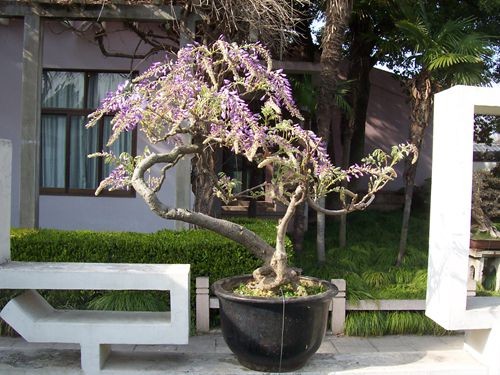
Common styles for wisteria bonsai include curved-trunk, slanting-trunk, weeping-branch, cascade, waterside, and rock-clinging forms; the style can be chosen according to the different shapes of the stump. Because its leaves are relatively large, the crown is usually trained in a natural style rather than being wired into cloud-pad shapes. The training method relies mainly on pruning, supplemented by appropriate wiring and pulling. An old, gnarled, antique-looking wisteria stump can also be used as rootstock, with excellent varieties such as Japanese wisteria, which has smaller leaves and abundant flowers, used as scion for grafting, making the resulting bonsai more ornamental and artistic.
Shaping and pruning: crape myrtle tolerates pruning well and can be pruned into a standard tree form taller than a tree or a low-trunked round-headed tree shape. Heavy pruning or even sawing off the trunk is very effective for controlling crown height and shape, and the new shoots that sprout can bloom in the same year. After flowering, remove the flower clusters promptly to save nutrients and benefit flowering the following year.
Dormant-season pruning mainly involves adjusting the vine form so that its growth direction is fixed, thinning branches appropriately to make use of nutrient space, and removing some non-flowering branches. Post-bloom pruning can use heavy pruning of the previous year's branches and removal of excess buds to appropriately reduce height, ensuring the shrub form and sufficient vigorous branches for the current year's growth. After autumn, before flower bud differentiation, branches should be appropriately shortened and thinned to help preserve the lower buds of long branches so they differentiate into flower buds.
After leaf fall in winter, carry out a thorough pruning of the plant, removing dead and withered branches and shortening the current year's branches by 1/3 to 2/3 so that they vary in length and are arranged in a pleasing, staggered manner. In winter, move it to a cold room or overwinter it outdoors in a wind-sheltered, sunny spot; as long as the potting soil does not freeze, it will overwinter safely. After sprouting in spring, remove overly dense buds promptly so that nutrients are concentrated in the remaining branches, which favors flowering.
It grows quickly, lives long, and has a strong twining ability, so special attention must be paid to shaping and pruning during its growth. After wisteria is planted out, select and keep vigorous branches as the main vine to train, and cut off the immature tip portion. If there are side branches at the cut, remove 2 to 3 of them to reduce competition and make it easier to wind the main vine around the support. Besides producing one strong central main branch, the trunk will also produce several new branches that assist in nourishing the central main branch; these branches should be removed in batches. In the winter of the following year, shorten the central main branch on the trellis surface to a strong bud to prepare for producing strong main branches the next year. Keep two buds below the strong bud as the second and third main branches for training. After the wisteria framework is set, dead branches, diseased and pest-infested branches, and excessively tangled, overlapping branches should be cut off every winter.
Generally, small side branches are shortened to leave 2 to 3 buds, so that branches are evenly distributed on the trellis surface. Wisteria grows quickly, and its branches and vines become denser and heavier, so thinning should be carried out in winter or before budbreak in early spring to keep the branches and vines on the support at a reasonable density. Wisteria has a very strong twining ability and can strangle other plants, so attention must be paid to preventing the vines from climbing onto trees, and individual vines should be manually guided in time. Flower bud differentiation of wisteria generally begins in early June; if pruning is done after flowering, it will affect flower bud formation the following year, so wisteria is generally not pruned in summer. Even if pruning is done, only overly dense branches that affect light and tree shape are removed, and flower clusters that have already bloomed should be cut off from the base to prevent pod formation from consuming nutrients. Wisteria can also be grown in pots or made into stump bonsai; usually attention should be paid to strengthening pruning and pinching to control the plant's shape and size. Each year, when new shoots are about 15 cm long, they should be pinched once, and after flowering they can be heavily pruned once more.
In classical gardens, wisteria is also often placed beside rockeries; when young, it should be guided more actively so that the vines thread through and cling to the rocks. Once mature, pruning should be strengthened so that the branches and vines intertwine, twist, and wind like a writhing dragon, with strings of wisteria flowers hanging down, delighting the eye and creating a distinctive scene.