A Detailed Guide to the Propagation Methods of Saffron (Crocus sativus)
Crocus sativus, also known as saffron crocus or saffron, is a perennial flowering plant in the genus Crocus of the family Iridaceae, and also a common spice, a perennial herbaceous plant. Saffron is a bulbous plant and a rare cold-hardy variety. The most commonly used propagation method is division of the corms. Divide the saffron corms in August to September before the flowering period, and when they bloom you will see many replica saffron plants! Let's take a look at the specific propagation methods!
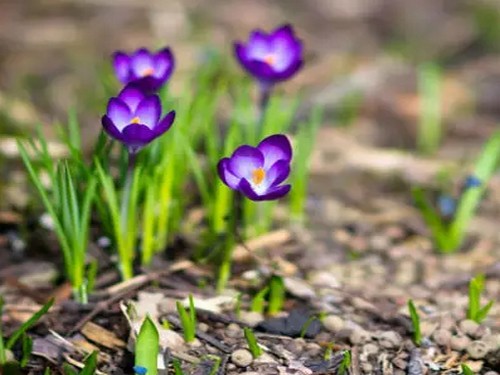
Division propagation of saffron:
Timing of division:
Saffron's growing season is in winter and spring. There are two varieties, one flowering in autumn and one flowering in spring, and division is usually carried out in August to September. The earlier the division, the more favorable it is for strong seedlings.
Selecting the corms:
After flowering in spring, the faded flowers should be removed immediately to avoid nutrient consumption, and 1 to 2 applications of a compound fertilizer solution mainly containing phosphorus and potassium should be given to promote strong and robust corm growth, after which normal care continues. By summer, when the above-ground parts turn yellow and withered, take out the corms, dry them in the shade, and store them.
Storing the corms:
Cut off the remaining leaves level with the top, remove the remnants of the mother corm, then move them indoors, grade them by size, and place them on indoor rack shelves. There is no need to bury them in soil; place the corms with the bud tips facing upward, laid flat in rows in the tray, with slight gaps between the corms.
Indoor potted division:
In autumn, depending on the shape of the corms, those with daughter corms can be divided. Simply break them apart by hand and plant them in pots.
Care after division:
After division, appropriately increase the indoor air humidity and keep the soil moist. This promotes the corms to sprout.
After mid-August, temperatures drop, so cooling measures are generally not needed. The suitable temperature for saffron is 15-18°C; controlling the indoor temperature well after division can promote flowering.
Seed propagation method for saffron:
Saffron does not easily set seed and requires hand pollination to obtain seeds. So if you want to use the seed propagation method, you can buy seeds from a flower shop.
In spring and autumn, sow the seeds directly in pots, with 5-10 cm between seeds, sparser being better. Because the plants need to grow corms, the pots must not be repotted or the soil loosened within 2 years.
From sowing the seeds to the plant flowering takes 3-4 years. During this period, appropriate watering and fertilizing are all that is needed.
Crocus sativus can be propagated by division and by sowing, but division propagation is the main method.
Division propagation:
Generally carried out in August to September. Mature corms have multiple main and lateral buds. After flowering, new corms form from the swollen base of the leaf cluster. After the above-ground parts wither in summer, dig out the corms, grade them, dry them in the shade, and store them. Planting earlier is favorable for forming strong seedlings.
Each mature corm has several main buds and lateral buds. When planting, large corms weighing more than 8 grams should be planted separately from small ones. Small corms weighing less than 8 grams will not flower that year and need another year of cultivation. For pot cultivation, it is best to select spring-flowering corms weighing about 20 grams in October, use pots with an inner diameter of 15 cm, and plant 5 to 6 corms per pot. After planting, place them outdoors for care first. They root after about two weeks; then move them indoors to a spot with ample light and fresh, moist air, and they will bloom around New Year's Day.
After flowering, the faded flowers should be removed immediately to avoid nutrient consumption, and 1 to 2 applications of a compound fertilizer solution mainly containing phosphorus and potassium should be given to promote strong and robust corm growth. Continue normal care until the above-ground parts turn yellow and withered in early summer, then take out the corms, dry them in the shade, and store them. Saffron can also be grown in water for ornamental purposes, in the same way as narcissus bulbs are soaked.
Seed propagation:
Because saffron does not easily set seed, seeds can only be obtained after hand pollination. Once the seeds are mature, sow them as soon as they are collected in an open-air seedbed or in pots. The sowing density must not be too high; sparser is better, because the plants need to grow corms and generally cannot be dug up within 2 years. From sowing the seeds to the plant flowering often takes 3-4 years.