Detailed Guide to Seed Propagation Techniques for Elderberry: Mastering the Key Points of Seedling Cultivation
Elderberry, also known as Gongdao Lao, is a deciduous shrub to small tree of the genus Sambucus in the honeysuckle family (Caprifoliaceae), widely distributed across both northern and southern parts of China, and is a perennial clumping shrub. The flowers are white, and the fruits are bright red like fire, covering the entire tree and persisting. It has strong adaptability, is drought-tolerant, tolerant of poor soil, and can withstand low temperatures of -50°C, making it one of the common tree species in local landscaping. Elderberry can be propagated by cuttings, division, or seeding. Cutting and seed propagation are simple and easy to carry out, and a large number of seedlings can be obtained at once, making them the most commonly used methods. Below is an introduction to the seed propagation techniques for elderberry.
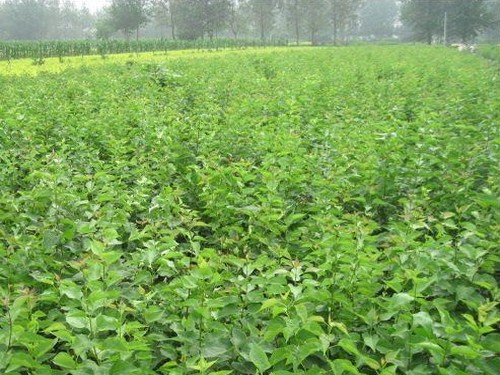
When the fruits are ripe, collect seeds from plants with good form and robust growth. After cleaning the seeds, place them in a shaded area and store them in a clean cloth bag. In early November, mix the seeds with sand at a ratio of 1:3, keep them moist, and stratify them in sand in an open shaded area, covering with a straw mat or burlap sack, and turn them over frequently. In early April of the following year, broadcast sow the seeds at a seeding rate of 15 g per sq m. After sowing, cover with clean fine sandy soil at a thickness of 0.5 cm. Seedlings can emerge in about 10 days. After 3 to 4 leaves have grown, thinning can be done on a cloudy day. During the maintenance period, weeds should also be removed promptly. In mid-June, apply a top dressing of urea once, and in late autumn apply cow or horse manure once, and water thoroughly with enough anti-freezing water. Transplanting and cultivation can be carried out in the spring of the following year.
1. Seed collection
Elderberry seeds mature early, generally ready for collection from late July to early August. After collecting, rub the seeds to remove the skin, select seeds with clean water, soak them in 0.2%-0.5% alkaline water for 30 min, then rinse the seeds clean with clean water.
2. Site selection
Choose a site that is sheltered from wind and facing the sun, with high and dry terrain, convenient drainage and irrigation, high soil organic matter content, and sandy loam soil. Generally, autumn plowing and autumn preparation are done, applying 2,500 kg of organic fertilizer and 15-20 kg of potassium dihydrogen phosphate per 667 sq m, mixing evenly, harrowing fine, and making seedbeds 1.0 m wide and 15 cm high, with the seedbed required to be firm below and fine on top.
3. Germination promotion and sowing
Elderberry seeds have a dormant characteristic and require alternating high and low temperature treatment. In early September, mix the seeds with sand at a seed-to-sand ratio of 1:3, maintain a relative moisture content of 60%, and stratify in sand in the open until mid-April of the second year. Take out the seeds and broadcast sow at a seeding rate of 10 g per sq m, then spread 0.5% of the sowing rate of quintozene toxic soil over the seeds, and cover with 0.5 cm of soil.
4. Seedling stage management
(1) Thinning and final singling of seedlings. Elderberry grows rapidly, and timely thinning is the guarantee for cultivating strong seedlings. Generally, the first thinning is carried out 20 d after emergence, with a plant spacing of 10 cm; the second thinning is carried out 35 d after emergence, with a plant spacing of 15 cm; final singling is carried out 50 d after emergence, with a plant spacing of 25 cm.
(2) Weeding. In the early growth stage, elderberry seedlings are slender and weak, so weeds should be removed promptly. In the later stage, elderberry grows relatively fast and closes its canopy early, so there are fewer weeds.
(3) Water and fertilizer management. Elderberry has high tissue water content and grows fast, so water and fertilizer management should be strengthened. During the vigorous growth period of the seedlings, apply nitrogen fertilizer once every 7-10 d, at 3-5 kg per 667 sq m. The last fertilization is in early August, spraying 1-2 kg of potassium dihydrogen phosphate per 667 sq m to help the branches and trunks become firm and survive the winter safely.
5. Overwintering management
In late September, elderberry seedlings can reach a height of 1.7 m and a ground diameter of 2 cm. In mid-to-late October, dig up the 1-year-old elderberry seedlings with roots, place them in a cellar, align the roots, cover the roots with sand, pile them into long strips, and finally water the roots, maintaining the cellar temperature at -3°C to 5°C, and store until the following year for planting.