How to fertilize Chaenomeles speciosa bonsai? A full breakdown of practical tips
Chaenomeles speciosa (flowering quince) has a very long history of cultivation in China. According to research, the “mao” mentioned in the Erya is this plant. The flowers of Chaenomeles speciosa come in diverse colors, including vermilion, peach red, and moon white, and some cultivars have petals mottled with pink and white; moreover, its petals are smooth and translucent, making it very beautiful. Its branches are dark black, curving like iron wire, which very much suits the aesthetic tastes of the ancients, making it an excellent material for making traditional-style bonsai. This trend also influenced Japan and Korea, and the horticultural circles of Japan place great importance on the cultivation of Chaenomeles speciosa, having bred new horticultural cultivars.
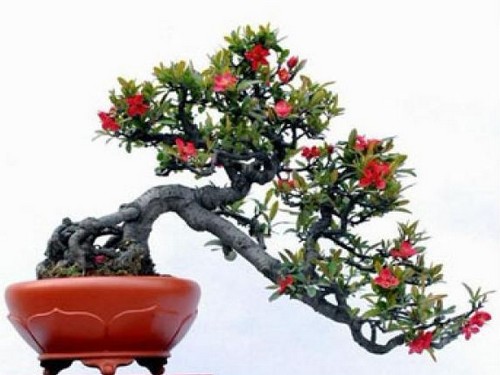
The fruit of Chaenomeles speciosa has a peculiar shape, like an upside-down pear, hence it is also called “iron-foot pear”; and because compared with the fruit of Chaenomeles cathayensis —— the Chinese quince —— it becomes slightly wrinkled after ripening, it is also called “wrinkled-skin Chinese quince”. As for being called “Sichuan Chinese quince” and “Xuancheng Chinese quince”, that is because Sichuan and Xuancheng in Anhui abound with this plant.
Chaenomeles speciosa can tolerate both drought and poor soil, so its cultivation and management are relatively extensive. In order to make the clump grow luxuriantly with many and brightly colored flowers, appropriate water and fertilizer management should be carried out, applying organic fertilizer (rotted barnyard manure or compost) once a year in autumn at the root zone of the clump. If the plant is not growing very weakly, there is no need for supplementary fertilizer during the growing period; simply increasing the amount of organic fertilizer in autumn is enough.
It likes fertilizer, and generally fertilizer can be applied three times a year:
The first is the post-flowering fertilizer in spring. This fertilizer is mainly nitrogen-based, and some rotted and fermented cow or horse manure or chicken manure can be applied at the same time. This fertilizer can effectively replenish the nutrients consumed by flowering, making the plant grow vigorously and in good condition;
The second is in July and August, during its flower bud differentiation period, applying some phosphorus-potassium compound fertilizer. Fertilizing at this time can promote flower bud differentiation and increase the number of flowers set;
The third is before the onset of winter, applying some base fertilizer together with the winter watering. For this fertilizer, sesame paste residue is best, as it not only has lasting fertility but can also effectively strengthen the tree's vigor and improve the quality of flowering the following year.
Note:
Chaenomeles speciosa is about to bloom, so there is no need to apply fertilizer; even if you must, apply only a little. Although this flower is very tolerant of poor soil, too much fertilizer makes the flower buds prone to dropping.