Detailed Explanation of the Key Techniques for Styling Chaenomeles speciosa (Flowering Quince) Bonsai
Chaenomeles speciosa is mostly trained in a shrub-clump form. After the clump is planted, generally 3~5 healthy branches are selected and kept, and these are cut back according to their growth vigor. Usually, strong branches are pruned lightly and weak branches heavily; where fertilizer and water conditions are good, prune lightly and leave long; where fertilizer and water conditions are poor, prune heavily and leave short. Leave an outward-facing bud at the cut, so as to expand the range of the clump. At the same time, remove excess and overly small branches flush with the base, so as to leave space within the clump, which is good for ventilation and light penetration, produces more flower buds, and can also promote the sprouting of robust new shoots from the root crown the following year, increasing the number of branches within the clump.
When pruning in the second winter, there are already several suckering shoots within the clump. These branches cannot flower that year and should not be kept in excess, lest the branches within the clump become too dense and affect ventilation and light penetration, so generally only 2~3 suckering shoots are kept and the rest are all thinned out. The selected suckering shoots must all be cut back appropriately, to encourage more medium and short branches in their middle and lower parts and lay the foundation for earlier flowering.
For the several scaffold branches that were cut back the previous year, renewal pruning should be carried out according to the growth vigor of the branches. Generally, 1~2 long shoots sent out from the upper end of the mother branch are removed together with a portion of the mother branch, so as to reduce the height of that branch. Then the long shoots and medium-short shoots below the cut are cut back separately; long shoots should be pruned lightly to moderate their vigor and promote flower bud formation on the short shoots below them; medium and short shoots need only be cut back leaving 2~3 buds. In this way, following its natural characteristics, a shrub-clump form is created.
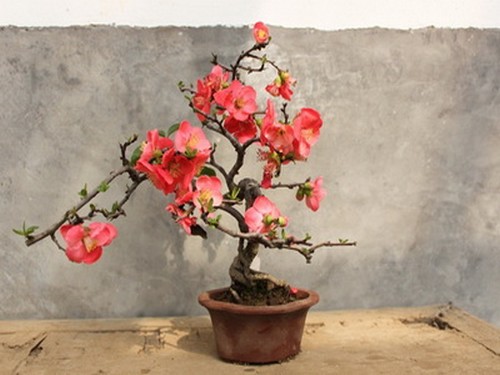
Chaenomeles speciosa has flowers that are gorgeous and delightful, and branches that are vigorous and slanting, hard and powerful. Firm yet supple, it is richest in antique charm. The fruit ripens in October and is golden yellow, also of considerable ornamental value, making it an excellent bonsai species for both flowers and fruit. Generally, a Chaenomeles speciosa bonsai takes about five years from rooted cutting to finished form, and moreover its branches are hard and prone to producing water sprouts, so wiring, pruning and shaping are all rather difficult. Through five years of practice, we have worked out a set of quick methods for styling Chaenomeles speciosa bonsai, described in detail as follows:
1. Cultivating plant form: For field-grown or pot-grown Chaenomeles speciosa, prune out diseased, weak and dead branches so that the interior of the clump is hollow, which is good for ventilation and light penetration. Also select large branches with distinctive form for careful pruning, pruning 3-5 times that year, so that the branches twist and extend; the last pruning should be completed before the end of July, otherwise it will affect flower bud differentiation and the following year's flowering will be sparse. At the same time, strengthen fertilizer and water management to ensure lush flowers and leaves.
2. Air layering: Air layering of Chaenomeles speciosa can be done right after the flowers fade. First girdle the selected large branch by 1-1.5cm; if 50-100pp rooting powder is applied, rooting can be advanced by 5-10 days. Then take a square piece of clean plastic film with a side of 15-25cm, drill a small hole in the center just large enough for the trunk to pass through, and cut from the middle of one side toward the center; slip the plastic film over the position 10cm below the girdle, tie it, then fold it upward into a pouch and fill it with prepared growing medium. The growing medium must be light and well aerated; generally use vermiculite, or leaf mold and decomposed sawdust plus a small amount of garden soil, mix evenly, sprinkle in an appropriate amount of water, and sieve while moist. Fill with 0.25-0.5 kg of growing medium, then tie the plastic film above the girdle at 5cm. In daily care, pay attention to maintaining the moisture of the growing medium inside the plastic film; if the growing medium turns white, water can be injected with a syringe, and pay attention to shaping.
3. Cutting off from the mother plant and cultivation: One month after layering, white tender roots will successively emerge at the girdle. When the number of roots exceeds 10, the total length exceeds 50cm, and the root color turns yellow, it can be cut off from the mother plant. According to the rooting situation, the size of the shoot tip and the thickness of the trunk, it can be cut off in 1-3 times. After cutting down, remove the plastic film and plant it in a flower pot slightly larger than the soil ball; at the same time, prune some branches or remove some leaves to maintain a balance between transpiration and water absorption. After keeping it in a shaded place for two weeks, it can enter routine care. Because Chaenomeles speciosa roots quickly, it must be repotted once that year. In winter, the flower pot can be buried in the soil outdoors to overwinter. The following year it becomes a bonsai with an antique and elegant posture, abundant flowers and lush leaves, and heavy fruit.
The characteristics of this method are a short styling time, requiring only 1 year; and the root system is uniform, so with slight root exposure it can form a coiled shape; the roots are small, suitable for planting in all kinds of landscape pots; flowers are abundant and leaves lush, with an antique and elegant posture, and it can be produced in large quantities at one time. According to experiments, air layering on 10-year-old old branches can still succeed in one attempt. The shortcoming is that exposed roots are not easy, requiring more than 2 years of root exposure before it is possible.