Hydrangea (Hydrangea macrophylla) Potted Cutting Propagation Method
The entire hydrangea plant is toxic. It has no particular smell itself, but if ingested it can cause colic, abdominal pain, diarrhea, shortness of breath, vomiting, bloody stool and other symptoms of poisoning. So it is best not to keep it indoors, and even more so, do not covet the beauty of its flowers and want to pick them to play with. If you have bought a potted hydrangea for your home, it is suitable to place it on a well-ventilated balcony or terrace for viewing.
As for propagating hydrangea, you can start taking cuttings from before the buds break in February (gardeners can also try it in other seasons; surprises only come after you try). Select semi-lignified branches about 20 cm long, remove the lower leaves, and if there are flower buds, cut them off. The suitable temperature for rooting cuttings is 13-18°C, and roots will form 15 days after inserting. Of course, some gardeners also root them in water, and they root that way too.
Yesterday I promised a fellow gardener that I would teach her how to take hydrangea cuttings, but the moment I agreed I forgot all about it the next second. Yesterday, while I was editing that post about hydrangeas, I just could not remember the matter of cuttings at all. So, I am truly sorry, and so~ today I am making up for it.
And this time of year also happens to be the best time to take cuttings, so you definitely should not miss it. If you do not want to waste the branches cut from the hydrangeas that have already bloomed at home, then learn how to take cuttings as well.
Hydrangea cuttings are actually very simple. The commonly used methods are nothing more than cuttings, layering, division and so on, but hydrangea propagation is basically based on cuttings. A few years ago I used the method for rooting rose cuttings to root several hydrangeas, with a 100 percent survival rate, so personally I feel it is much easier to root than rose cuttings.
However, I did not keep photos at the time, so today I will borrow a few of someone else's cutting photos as a demonstration. The pictures are from Baidu Tieba user Tufei Songye, thank you!
The specific steps are as follows:
1. Prepare the cutting medium and container. The picture below uses peat + perlite, a mainstream cutting medium. Of course you can also try other media. As for the container, if you are not rooting very many, a nutrient pot or a disposable cup will do; you do not necessarily have to buy this kind. After filling it, water thoroughly once to keep the medium moist.
2. Select tender branches of the current year and cut the branches as shown in the picture below, one pair of leaves per small section, then cut each leaf in half. This is done to reduce water evaporation. As for the length of the cutting, do not leave too much above the leaf surface, about 1-2 cm, and about 3-5 cm below the cutting. Leaving it too long is useless, and leaving it too short makes it unstable when inserted.
3. After all are inserted, water thoroughly once more so that there are no gaps between the medium and the cuttings. Finally, find a cool, well-ventilated place, remember to check every day, and mist to keep moist. Roots will grow in about one month. (Remember to report back to me once they have rooted.)
In addition, let me share with you a funny incident about buying hydrangeas: some time ago, when I was browsing various online shops wanting to pick up a few hydrangeas, I happened to see a negative review, and I burst out laughing right then.
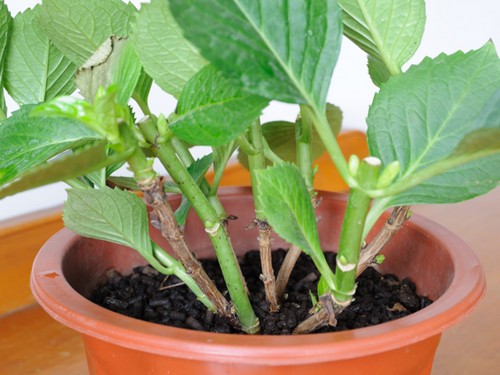
The story goes like this: a customer bought two potted hydrangeas last winter. When the delivery arrived and he opened the package, he found they were actually two pots of dead branches. He was furious on the spot, felt he had been cheated, so he broke those branches one by one and took photos as evidence to send to the seller to demand an explanation. In the end he was still furious and left a negative review, and it was this pot in the picture below:
I know it is not very kind of me to laugh, and I can imagine the seller must have been furious but helpless!
How should I put it? Anyone who grows flowers knows that hydrangeas do drop their leaves in winter, so when buying in winter, receiving bare branches is not strange at all, because as long as the temperature is suitable, it will sprout new leaves.
So when we like a certain flower, we should still try as much as possible to learn about its growth habits, what environment it adapts to, what soil, whether it likes sunlight and water and fertilizer, and its state in each season, and so on. Only then will we avoid making similar jokes.