How to Propagate the Flowering Almond (Prunus triloba)? A Detailed Guide to Its Propagation Techniques
Flowering almond seeds generally mature in mid-August. When the fruit skin turns orange-yellow or red-yellow, they are ready to harvest. After harvesting, remove the flesh from the fruit, dry it in the shade, screen it, and store it in burlap sacks or breathable containers in a cool, dry, well-ventilated place.
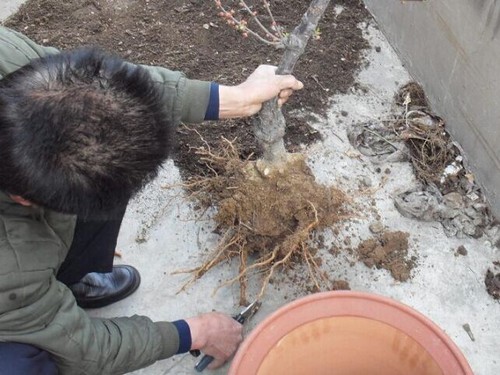
Flowering almond can be propagated by grafting, sowing, layering, and other methods, but grafting gives the best results: it takes only two to three years to grow into a plant that flowers and fruits. The main grafting methods are cleft grafting and bud grafting. Rootstocks can be wild peach, flowering almond seedlings, or apricot. Rootstocks generally need to be grown for more than two years, with a base diameter of about 1.5 cm. Before grafting, they must be cut off in advance, leaving a stub 5 to 7 cm above the ground.
1. Bud grafting: From late August to mid-September, determine the bud position on the branch previously selected as the scion. The bud to be grafted must be thick, plump, and free of dried tips, pests, and diseases. Using a sterilized budding knife, make an upward diagonal cut at a 30-degree angle into the xylem 2 cm below the bud position, extending to 1 cm above the bud position. Then make a horizontal cut 1 cm above the bud position, gently remove the bud, and at 3 cm above the ground on the rootstock, cut a "T" shape in the bark, 3 cm long × 2 cm wide. Gently lift the bark, insert the bud into the "T"-shaped cut so that the bud fits tightly against the rootstock, then cut plastic tape into narrow strips and tie it securely. After grafting, if the bud has not wilted after about 7 days, it has survived; after about 20 days, the plastic tape can be removed.
2. Branch grafting: In mid to early March of spring, take a branch about 8 cm long from a one-year-old double-flowered flowering almond as the scion, keeping 3 or 4 buds. On one side of the rootstock's cross-section, use a knife to make a vertical cut about 4 cm long between the xylem and the bark. Cut the lower end of the scion into a duckbill shape about 3.5 cm long, then insert the scion vertically into the cut in the rootstock, leaving a slight "white exposure," and wrap it tightly with plastic tape. To retain moisture, mound soil around it immediately. It will survive in about 20 days. After one month, gently scrape away the soil and remove the plastic tape.
Flowering almond can be propagated by grafting, layering, cuttings, sowing, division, and other methods. Among these, division and grafting are the most commonly used.
Grafting methods include bud grafting and branch grafting, with bud grafting generally used more often. Bud grafting is best done in mid to late August. The rootstock can be one-year-old flowering almond seedlings, or seedlings of wild rose species, hairy peach, or wild peach. For the bud, select plump leaf buds from one-year-old branches cut from a superior variety of flowering almond. Branch grafting should be done in February to March of spring. The scion should be cut before the plant buds. The scion can also be cut in winter and stored in sand for use in spring. Layering should be done in February to March of spring. Select two-year-old branches and, on the part to be buried in soil, make partial notches or ring-barking to encourage root formation. Roots generally form in about one month. Grafting mostly uses one- to two-year-old seedlings of wild apricot, wild peach, or flowering almond as rootstocks. Cleft grafting is done before buds sprout in spring; bud grafting in July to August; approach grafting can be done before June, and after one to two months, once healed, it can be separated from the mother plant. Seeds can be sown in autumn after maturity, or stratified in sand and sown in spring. Planting can be done from after leaf fall in autumn to before bud sprouting in early spring. In cultivation and management, attention should be paid to pruning and fertilizing after flowering to ensure enough flowering branches the following year.
Division can be done in autumn or in spring after the soil thaws and before the plant sprouts. After division, the plant should have 1/3 to 1/2 of its branches pruned off to reduce water evaporation, which helps the plant survive.
Sowing propagation of flowering almond is divided into autumn sowing and spring sowing.
Autumn sowing means sowing immediately after harvest. Autumn sowing is mostly done in mid to late October. The sowing method can be broadcasting or drilling, but drilling is best. The sowing depth is generally 2-3 cm, the sowing width is 30-35 cm, and the seeding rate is 150 kg per hectare. Autumn-sown seeds do not need pre-germination treatment beforehand; clean, purified seeds can be sown directly. However, autumn-sown seeds do not germinate that same year and need to overwinter in the nursery bed. Before sowing, soak the seeds in a 0.5% potassium permanganate solution for 2-3 h, or soak them at a 3% concentration for 40 min, then seal them for half an hour, rinse several times with clean water, and sow. Then water promptly for overwintering.
Spring sowing. Spring sowing of flowering almond is mostly done in late April or early May after the soil thaws. Before sowing, screen and purify the seeds stored over winter, soak them in 40°C warm water for 2-4 h, then take them out and mix them with 1-2 times their volume of wet sand, pile them indoors or in a shed kiln to germinate, turning them once every 4-5 h. When 40% of the seeds have cracked their shells and begun to sprout, they can be sown. Specific method: open furrows 60 cm apart running north-south or east-west, with a furrow depth of 2-3 cm, then evenly scatter the seeds in the furrows at 3-5 cm intervals, cover them with soil from both sides of the sowing furrow, then lightly press and water thoroughly.