How to Propagate Ipomoea cairica? Detailed Explanation of Propagation Methods
Ipomoea cairica (scientific name: Ipomoea cairica) is a perennial herbaceous plant in the order Solanales, family Convolvulaceae, genus Ipomoea, commonly known as Cairo morning glory or palm-leaf morning glory. It generally grows on mountains. The leaves are palm-like, with 5~7 lobes, about 3~10 cm in size; the flowers are funnel-shaped, about 4~6 cm in size, with 5 stamens, and bloom most abundantly in summer. Native to tropical Africa and Asia, it grows in full sun and well-drained environments, on flat ground, in roadside thickets in mountainous areas, and in sunny spots, and has a very strong climbing ability. The whole plant or root has medicinal properties; it can cool the blood and invigorate circulation, and strengthen the bones and muscles; it is mainly used to treat traumatic injuries, fractures, rheumatic swelling and pain, and amenorrhea.
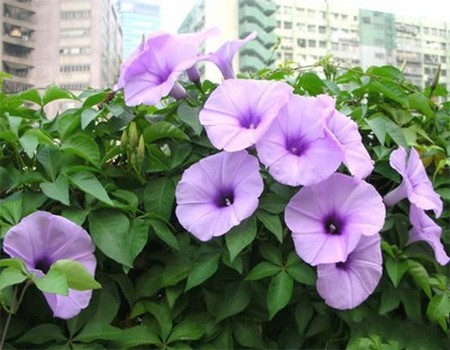
Ipomoea cairica prefers a sunny, warm and humid climate and loose, fertile soil. It mostly grows in sunny spots at low altitudes, in wall edges, eaves, flat ground or roadside thickets in mountainous areas. It is propagated by sowing or cuttings. Sowing in May is most suitable, covering with 1 cm of soil, and it can germinate in 5~6 days. Once the two leaves have unfolded, the seedlings can be pricked out.
Propagation by sowing:
Before sowing, the seeds must first be selected. Whether the seeds are well chosen directly affects whether sowing will succeed. It is best to use seeds harvested in the current year. The longer the seeds are stored, the lower their germination rate. Choose seeds that are plump, free of damage or deformity, and free of pests and diseases. For home seed disinfection, it is common to soak the seeds in hot water at about 60°C for a quarter of an hour, then use warm water to promote germination for 12~24 hours. To disinfect the sowing substrate, the best method is to put it in a pot and heat it until hot; any pests or diseases will be scalded to death. Soak the seeds in warm water (at a temperature similar to face-washing water) for 12~24 hours, until the seeds absorb water and swell. For very common seeds that germinate easily, this step can be skipped.
For tiny seeds that are difficult to pick up with your hands or other tools, you can moisten one end of a toothpick with water, stick the seeds one by one onto the surface of the substrate, cover with 1 cm of substrate, then place the sowing pot into water, with the water depth at 1/2~2/3 of the pot's height, and let the water slowly soak up (this method is called the "pot soaking method").
For larger seeds that can be picked up with your hands or other tools, place the seeds directly into the substrate and sow them in spots at a spacing of 3×5 cm. After sowing, cover with substrate to a thickness of 2~3 times the size of the seeds. After sowing, use a sprayer or a fine-holed watering can to moisten the sowing substrate, and later water again when the pot soil is slightly dry. Still be careful not to water too forcefully, so as not to wash the seeds out.
Propagation by cuttings:
Softwood cuttings are often taken from current-year branches in late spring and early autumn, or hardwood cuttings are taken from last year's branches in early spring. When taking softwood cuttings, during the period of vigorous growth from late spring to early autumn, select robust current-year branches as cuttings. After cutting off the branches, choose the sturdy parts and cut them into sections 5~15 cm long, each section carrying more than 3 leaf nodes. When cutting the cuttings, note that the upper cut should be made flat about 1 cm above the topmost leaf node, and the lower cut should be made at an angle about 0.5 cm below the bottommost leaf node; both the upper and lower cuts should be smooth (the knife must be sharp). When taking hardwood cuttings, after the temperature rises in early spring, select robust branches from the previous year as cuttings. Each cutting usually retains 3~4 nodes, and the cutting method is the same as for softwood cuttings.