How to Shape a Camellia Sasanqua Bonsai? A Full Guide to Methods and Techniques
Camellia sasanqua has been favored by people since ancient times. It has a delicate form, elegant leaves, brilliant flower colors, and a long blooming period, making it a famous flowering plant prized both for its flowers and its foliage. The purpose of making a camellia sasanqua bonsai is appreciation, and the prerequisite for appreciation is being able to give the camellia sasanqua good shaping, so how to shape it is a very important point. Below, the editor will tell everyone some methods for shaping camellia sasanqua.
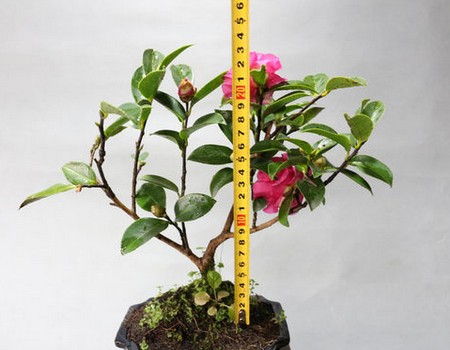
Pruning and shaping of camellia sasanqua can be done throughout the year, but it is best to do it during the period from after flowering to before new shoots sprout. The time for pruning and shaping can be extended from December to February to March of the following year. To master pruning and shaping, the following principles should be grasped: the cut should be smooth without leaving a stub, each plant should keep 3 branches, and the leader branch on each branch should be reserved in advance.
[Trunk Treatment]
It is necessary to combine the natural characteristics of different camellia sasanqua varieties and shape the trunk by methods such as climbing and tying or twisting, or the top shoot can be cut off to prompt the young buds in the leaf axils to sprout quickly, increasing branching, which is helpful for forming a crown and layers. The main trunk can also be cut off while retaining side branches, gradually building up a gnarled crown year by year, but note that the trunk and branches should be symmetrical to each other.
1. For the straight-trunk style, the trunk should be upright or the main trunk slightly curved, with the base of the main trunk slightly thicker and gradually becoming thinner upward.
2. For the double-trunk style, it is appropriate for the secondary trunk to emerge near the base of the trunk, and the heights should differ.
3. For the slanting-trunk style, the trunk should lean, but it must not lie flat. Generally, it is kept at about 45°, and the leaning part of the trunk should be more than one-half of the total length. The crown should finally be set upright.
4. For the curved-trunk style, the bending of the trunk should be natural, with moderate proportions. Do not bend back and forth on the same plane; it should be staggered from front to back in an orderly way.
[Branch Treatment]
The length and density of the branches should be coordinated with the height and thickness of the trunk. Overly dense branches can be pruned moderately. Do not let it bloom in the first two to three years, and do not be too impatient during the shaping process.
Because the branches are rather brittle and hard, especially at the branching points, they are very easy to break, so special care is needed. For individual slender branches, apart from removing or shortening water sprouts, generally lead wire should be used for twisting to shorten them. In shaping, it is better to be coarse than fine, and processing and shaping year by year is best.
[Leaf Treatment]
By treating the branches, leaves and small twigs and combining them skillfully, a reasonable layout and coordinated proportions are achieved.
The relationship between leaves should be handled so that many are not cumbersome and few are not sparse. To coordinate the leaves with the plant, some can be pruned off appropriately.
During the cultivation process, properly limit fertilizer and water to make the leaves as small as possible.
[Root Treatment]
Root treatment should be combined with the posture of the trunk. For example, the roots of the straight-trunk style are best slightly exposed, while the roots of the curved-trunk style can be exposed a bit more, preferably with twisting roots. For the cliff-hanging style, the roots are best exposed on the opposite side of the downward hang.