Detailed Explanation of Key Techniques for Propagating Witch Hazel (Hamamelis) from Seed
The flowers are uniquely shaped and fragrant, opening in early spring before the leaves, with slender yellow petals like golden threads covering the branches, very endearing. It is often cultivated in gardens both in China and abroad, and some fine cultivars have appeared; it is one of the famous ornamental flowering trees. It is very suitable for courtyard corners, poolside, stream banks, among rocks and at the outer edges of groves. In addition, flowering branches can be used as cut material for vase arrangements. If forcing is desired, cut the branches between December and January of the following year, place them in a vase in a greenhouse at around 20°C, and they will bloom in about 10-20 days.
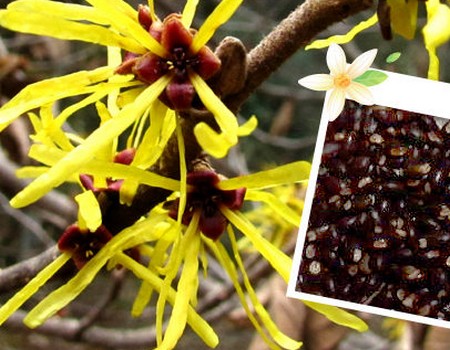
The fruit of witch hazel is a capsule, which tends to split open after ripening, so it should be harvested in time and placed in a bamboo winnowing basket with a cover for sun-drying, to prevent the seeds from being ejected and lost.
After the seeds are collected, they can be sown immediately, or stored in sand and sown again when spring warmth arrives the following year.
For seed propagation of witch hazel, the seedbed should be chosen on a sunny, dry site with deep, fertile, slightly acidic soil. Apply some piled dry mixed manure or barnyard manure, then deep-plow, break up the soil finely and rake it level to make an open-field seedbed.
The size of the seedbed should be determined by the amount of seed and ease of working; generally the length is 300-400 cm, the width 80-120 cm, and the height 30-35 cm.
Once the seedbed is ready, sieve the seeds out of the river sand and broadcast them in the seedbed, cover with fine sandy soil, and water thoroughly with a watering can. The seedbed should also be covered with rice straw, taking care to keep the soil moist; after the seedlings emerge, remove the straw cover promptly.
When the seedlings have grown 4-6 true leaves, remove weeds promptly and strengthen fertilizer and water management. In summer, build a shade frame to prevent exposure to the scorching sun.
In autumn, thin the seedlings once according to their density in the seedbed, and at the same time shorten the main root to promote the growth of lateral roots and fibrous roots.
Generally, after 1-2 years of careful cultivation, field planting is carried out in the third spring before the spring shoots begin to sprout.
The flowering period of witch hazel is from December to March of the following year. The fruit ripening period is October. The capsules are yellowish-brown when ripe and have the habit of ejecting the seeds when the capsule splits open. Therefore, the harvested fruits should be covered and dried in the sun to avoid loss of seeds. The thousand-seed weight is 65 grams.
The seeds have a long dormancy period, so they do not germinate in the year of sowing and do not emerge until the following spring. Therefore, the seeds are mostly stratified in wet sand for 1 year, then sown in autumn or spring. Drill sowing is used, with a row spacing of 20-25 cm and a sowing depth of 2 cm. After sowing, cover with soil; after emergence, provide shade and keep the soil moist. In the rainy season, take care to prevent waterlogging, and stop shading in mid-to-late September. The seedlings continue to be cultivated in place for another year. After the end of the second year's growing period, transplant them again to cultivate larger seedlings.