What are the propagation methods for Rosa xanthina? A guide to easy propagation
Rosa xanthina is an important ornamental flowering shrub in northern China in late spring and early summer. When in bloom, it is a mass of golden yellow. Also known as yellow rose, the name also refers to the flowers of this plant. The blossoms are vivid and eye-catching, and the flowering period is fairly long, making it suitable for garden viewing, group planting, and flower hedges. The plant has a graceful form, and when in full bloom, each golden-yellow flower set against the green leaves looks especially brilliant and striking. It is an important spring-flowering shrub in gardens in northern China, growing on lawns and roadsides, and can also be planted as a flower hedge.
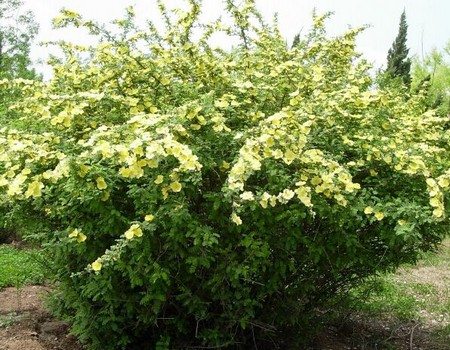
Planting Rosa xanthina is generally done from late March to early April. It should be planted with a soil ball. When planting, apply 1 to 2 shovelfuls of rotted compost in the hole as a base fertilizer, prune heavily after planting, and water thoroughly; water again about 3 days later, and it will survive. Rosa xanthina is easy to grow, requires only rough management, and has few pests and diseases. Propagation is mainly by division. Because Rosa xanthina has strong tillering ability and the double-flowered type generally does not bear fruit, division propagation is simple, fast, and has a high survival rate.
The main propagation methods for Rosa xanthina are division and grafting. Since the double-flowered type does not bear fruit and only the single-flowered type does, the single-flowered type can also be propagated by sowing.
1. Division propagation
This is generally done in mid-to-late March, before the buds sprout. Before dividing, first prune the branches heavily, dig up the entire plant, and divide it into several portions, each with at least 1 to 2 branches and some roots. After the seedlings are planted, strengthen fertilizer and water management. After flowering, prune the spent flowers and overly old branches fairly heavily to encourage renewal. Division propagation is easy to establish, convenient to manage, and can bloom in the same year; the downside is that the number of propagules is limited. Dig out the entire clump, divide it into several portions, each with at least 1 to 2 branches and some roots, then replant them separately and water thoroughly after planting.
2. Grafting propagation
Bud grafting is mostly used, generally in March or October. The buds used for grafting Rosa xanthina are plump dormant buds selected from the middle and upper parts of the current year's suckers and current-year side branches. Leaf buds from this part are easy to sprout after grafting and give a high rate of established plants. To make the leaf buds plump and well developed, pinch out the growing tips 2 to 3 days in advance. The scion is best cut and used immediately; after cutting, remove all leaves, leaving only the leaf stalks, and wrap it in a damp cloth or place it in a bucket of water. If conditions prevent grafting right away, the scion can be buried in a shady spot and the soil kept moist. The rootstock is generally two-year-old rose.
About 10 days after grafting, check for survival. If the grafted bud is fresh and falls off at a touch, it has taken; if the bud is shriveled and the leaf stalk does not fall when touched, it has not taken and can be re-grafted in time. Note that if the soil is dry and short of water before grafting, water early to promote sap flow. Grafting propagation is simple and easy, gives a high propagation rate, and the grafted plants grow quickly and bloom abundantly, and are also easy to shape and prune.
For grafting, use the easy-to-root wild rose as the rootstock and current-year branches of Rosa xanthina as the scion, grafting from December to early January of the following year. The rootstock is about 15 cm long; take a Rosa xanthina bud with a little wood, cut the top of the rootstock with wood attached, place the Rosa xanthina bud against it, bind tightly with plastic film, make bundles of 50 plants, dip in mud slurry, and store in moist sand to promote healing and rooting. After mid-March, plant out separately for growing on, with a spacing of 20 cm×40 cm; the survival rate is about 40%.
3. Cutting propagation
For cuttings, in the rainy season cut current-year woody branches, 10-15 cm long, keep 2-3 leaves, insert 1-2 cm into sand, with a spacing of 5 cm×7 cm.