Detailed Explanation of Photinia Cutting Propagation Methods and Techniques
The photinia has a rounded crown, glossy green leaves, purplish-red young leaves in early spring, scattered white flowers in late spring, and abundant red fruits in autumn, making it highly ornamental. It is a well-known garden landscaping tree species, resistant to smoke, dust and toxic gases, and also has soundproofing functions.
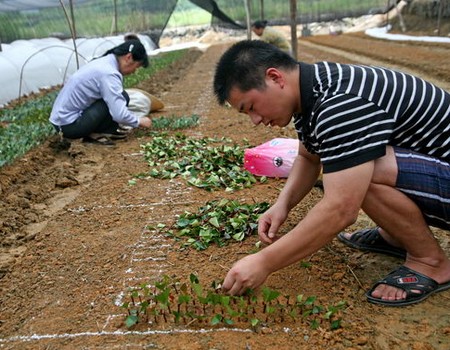
Photinia propagation mainly uses two methods: sowing and cutting. Below, we introduce the cutting propagation techniques for photinia.
1. Preparation of cutting facilities and seedbed
For cutting in a single-unit greenhouse, cover it with greenhouse film and add a shade net. After leveling the ground inside the greenhouse, build a ground-level cutting seedbed. The seedbed width should be about 100 cm, with 10 to 12 cm high retaining boards installed around it. Spread a layer of fine sand at the bottom of the seedbed to facilitate drainage. The cutting substrate can be vermiculite plus peat, or clean yellow subsoil plus fine sand. The seedbed and substrate must be disinfected with fungicides and insecticides to prevent pests and diseases.
2. Cutting time
Spring cutting in early March, summer cutting in early June, autumn cutting in early September.
3. Cutting of cuttings
Use semi-lignified young shoots or lignified current-year branches, cut into one leaf and one bud, about 3 to 4 cm long, with smooth cuts.
4. Treatment of cuttings
After cutting the cuttings, pay attention to moisture retention and insert them as soon as possible after cutting. Before cutting, treat the cut ends with a rooting agent to speed up rooting and increase the survival rate. The cutting depth should be 3 cm, and the density should be 400 plants per sq m. After inserting, water thoroughly immediately, and spray the leaf surfaces with a mixed solution of carbendazim and anthracnose fumei.
5. Management after cutting
After cutting, check the seedbed frequently. The substrate moisture content should be maintained at about 60%, the air humidity inside the greenhouse should preferably be kept above 95%, and the temperature inside the greenhouse should be controlled below 38°C. If the temperature is too high, spray water to cool it down. From cutting until rooting and sprouting, shade is required.
After 15 days, some cuttings begin to root, so the substrate moisture content should be appropriately reduced, generally maintained at about 40%. When more than 50% of the cuttings begin to root, gradually open the film for ventilation, with a shading light transmittance of about 50%.
When all the cuttings have rooted and more than 50% have produced leaves, gradually remove the greenhouse shade net and film and begin hardening the seedlings. Foliar fertilizer spraying or low-concentration water-soluble fertilizer application can be combined to promote vigorous growth of the cuttings.