What are the propagation methods for the bird cherry? A detailed guide
The bird cherry's young leaves are fresh green, while its old leaves are purplish red; paired with other tree species, the red and green set each other off beautifully. In gardens and scenic areas, it can be planted alone, in clumps, in groups, or in broad masses, or grown into large colorful hedges and large flowerbed patterns; it can also serve as a secondary street tree along urban roads and as an ornamental tree in residential landscaping. It is also suitable for planting on lawns, at corners, at fork roads, on hillsides, by riversides, beside rocks, in courtyards, in front of buildings, at gate plazas and other such sites.
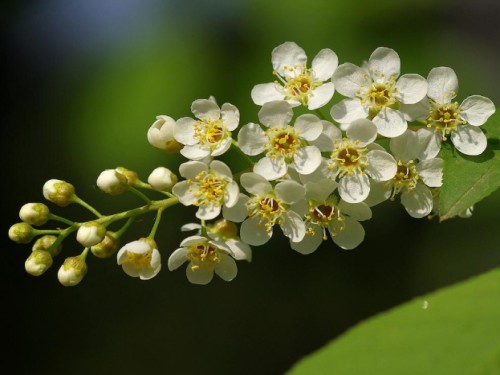
Bird cherry is mainly propagated by sowing or cuttings. Below is a brief introduction to these two methods.
1. Propagation by sowing
Seed collection: In Liaoning, the seed collection time is around mid to late August; the seeds can be harvested when the fruit turns black. After collection, soak them in water, rub them by hand to remove the outer seed coat and flesh, wash the seeds clean with clear water, and dry them thoroughly in a cool, ventilated place to prevent the seeds from heating up, molding or rotting, which would reduce their viability.
Seed treatment: Store the seeds in a cellar at 0-5°C. In late autumn, choose a dry, well-drained, wind-sheltered, sunny spot and dig a pit 1.5 m deep, spread 15 cm of gravel or coarse sand at the bottom of the pit, and insert a bundle of straw in the middle of the pit for ventilation. The length and width of the pit depend on the amount of seed. Before storage, soak the seeds in 40°C warm water for 2 days, then mix the seeds with moist sand at a volume ratio of 1:3, put them into the pit, and fill until 20 cm from the ground, then backfill with soil, with the soil mounded 10 cm above the ground. Dig drainage ditches around it.
Sowing: In early April of the following spring, take the seeds out of the pit and place them in a cool place to begin germination. Once 1/3 of the seeds have sprouted white, they can be sown. Choose flat terrain with convenient irrigation and drainage, deep soil, and loose sandy loam. Before sowing, apply sufficient base fertilizer, preferably 50 kg per 667 m. Prepare the land carefully and make ridges; the ridge surface should be level, and irrigate thoroughly with bottom water. Wait until the water has seeped away and the soil is slightly dry, then use a hoe to open furrows and broadcast the seeds evenly; the sowing rate is preferably 5 kg per 667 sq m. After sowing, cover with soil, preferably 1.5 cm thick, and press lightly after covering; afterward keep the ridge surface moist.
2. Propagation by cuttings
Bird cherry roots easily from cuttings. Hardwood cuttings are generally used rather than softwood cuttings, because softwood cuttings have fairly strict requirements for environmental conditions, especially temperature and humidity, and the transplant survival rate of softwood cuttings is not as high as that of hardwood cuttings.
Collection of cuttings. In autumn, select vigorous current-year mother shoots of bird cherry about 1 cm thick as cuttings.
Storage of cuttings. After collecting the shoots, cut the cuttings into 15-20 cm long pieces, bundle 100 pieces into 1 bundle, and store them in a cellar buried in sand. For cutting in the following spring, take the cuttings out of the cellar and soak them in clear water for 2-3 days, then insert them upright in the prepared seedbed at a plant spacing of 15 cm and a row spacing of 25 cm. After cutting, irrigate so that the cuttings are in close contact with the soil, promoting rooting and survival.