What are the ways that Impatiens spreads its seeds?
Impatiens is a slow-growing plant, and you need to start the seedlings about three months before the last spring frost. Impatiens seeds can take up to 21 days to germinate, with germination occurring within the first two weeks. So what does Impatiens rely on to spread its seeds?
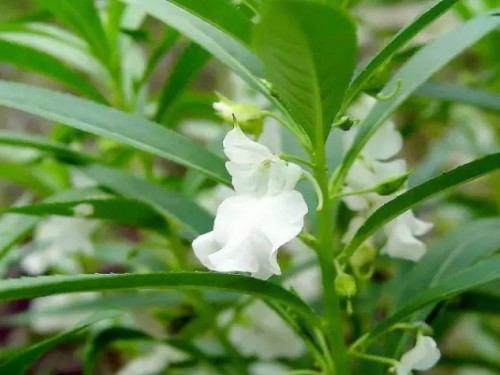
Impatiens spreads its seeds not by wind, not by animals, and not by water, but by "self-reliance." When its fruit splits open, the skin of the fruit curls inward and then suddenly stretches outward, flinging the seeds out. There is also a plant called the squirting cucumber; when its fruit is nearly ripe, a lot of mucilage forms inside it, and once the fruit drops from its stalk, the skin immediately contracts, producing great pressure, and the mucilage and seeds are shot out together from where the stalk was, able to fly 5-6 m away!
Some gardeners trying to save money may try broadcasting the seeds into trays and then transplanting the small seedlings once they have grown new leaves, but you will reduce the chances of transplant shock if you start the seeds in individual small pots or six-pack cells. You have to transplant the seedlings somewhere anyway, so you might as well start them in their final home. Any empty cell where a seed does not germinate is a very small price to pay for healthy, sturdy Impatiens.
Planting Impatiens seeds is a slow process, but a simple one. Fill moist commercial seed-starting mix, stirring it, leaving half an inch of space between the top of the soil and the rim of the planter in each cell. Set the cells on a tray and fill the tray with water. Allow the combination to absorb water from the bottom until the top of the mix is moist. Pour out the remaining water from the tray.
Place two seeds on the soil in each cell and sprinkle a light dusting of the mix over them. Mist the tops of the cells with clean water. Cover the cells with plastic to retain moisture and put it in a bright spot to sprout.
Once the seeds have germinated and produced a pair of leaves, remove the plastic and place the tray full of cells in a sunny south-facing window. If you cannot provide a bright window, grow Impatiens under fluorescent lights for 16 hours a day.
Some gardening experts believe that Impatiens seeds really do need an initial burst of sunlight to wake the seeds when they are spread, and they grow stocky if you then move them to a dark area. Experiment with this theory by leaving the seeds discovered for two days in a sunny window. Then sprinkle the seeds, stir the mix, cover with plastic wrap, and move them to a dark place to germinate.
The fruit of Impatiens also bursts open; it flings with more force than wood sorrel, sending seeds flying in all directions, and it can be counted as yet another example of mechanical seed dispersal.
Plants are the spirits of nature, and in order to reproduce, over the course of evolution they use their own unique wisdom to spread their seeds: some simply drop naturally, some rely on wind, and some rely on animal droppings and animal fur. But there is a rumor that when Impatiens spreads its own seeds, it uses a mechanical catapult method to fling the seeds out in an instant. So is this true?
To find out, a CCTV Finance reporter went to the Institute of Botany of the Chinese Academy of Sciences to verify this rumor. Impatiens, also known as henna, was formerly used by women in folk tradition to dye their nails a beautiful color with its flowers and leaves. Through careful observation, the reporter found that Impatiens does not look particularly remarkable, having neither brilliant colors nor a strange fragrance, and apart from the oval ball-shaped objects hanging one by one on the flower stems, it is no different from ordinary flowers.
And these ball-shaped objects are exactly where Impatiens stores its seeds, known scientifically as capsules. Right now is the season when Impatiens seeds mature, and the capsules have already begun to swell. So can this Impatiens, which looks so ordinary, really spread its seeds by a peculiar catapult method? The reporter waited for 2 hours and did not see any seeds being flung out, and could not help doubting what netizens said.
Seeing this, Teacher Wang of the Institute of Botany of the Chinese Academy of Sciences told the reporter: "Impatiens really can catapult its seeds on its own, and it can also fling its seeds open under the stimulation of external force. When the fruit of Impatiens is mature enough, for example the blowing of wind or the tapping of raindrops will cause its fruit to burst open. In fact, under natural conditions, small animals brushing back and forth among the flowers, and the touch of a human hand, will likewise cause its fruit to burst open."
So the reporter tentatively touched a capsule with a hand, and at that moment a magical scene appeared. Just as the reporter pinched the capsule, the seeds suddenly shot out from inside the capsule at a speed that caught one off guard. The reporter then used other methods to stimulate several capsules, and the same situation occurred again.
Although during the waiting process the reporter did not observe Impatiens catapulting its seeds on its own, through external stimulation the capsules of Impatiens really did fling their seeds open. So exactly what principle does Impatiens use to fling its own seeds out? Why did it choose such a way to spread its seeds?
Teacher Wang said: "The fruit of Impatiens is made up of many split fruit-skin pieces, and when mature there is a mechanical tension between these fruit pieces, an inward tension, and under external touch or external stimulation it will spring open, and each split fruit piece will curl up, and during this process a certain elastic force will fling the fruit out. In the wild, the growing conditions are generally a relatively moist and shady growing environment, and it is generally hard to have a very good way of dispersal, so after long-term evolutionary selection, it chose to rely on its own strength to catapult the seeds out." So, is Impatiens the only plant that uses a catapult method to spread its seeds?
Senior engineer Zhang Huijin of the Institute of Botany of the Chinese Academy of Sciences told the reporter: "Besides Impatiens, there are also many plants that use a catapult or jet method to send out seeds. For example, the squirting cucumber, some plants of the Fabaceae, and plants of the Violaceae all use catapult-type dispersal."