How to shape a Serissa bonsai? Detailed methods
Different tree species each have their own way of being worked! As for Serissa, its exposed roots are the most fun to work with, so I suggest: shorten the upper branches and trunk, establish primary and secondary structure, raise the roots upward, and take it slowly - you can't rush bonsai!
1. Processing: Serissa is generally shaped by a combination of pruning and wiring. The main branches need only be wired appropriately, while the rest are shaped by pruning. Palm fiber is best for wiring, and care should be taken not to damage the branches or bark when bending them into shape. Old root stumps can also be given exposed-root treatment to enhance the beauty of the tree's form.
2. Tree forms: Common Serissa bonsai forms include slanting trunk, curved trunk, cascade, clump, and exposed-root styles. Serissa is also suitable for use in landscape bonsai and water-and-land bonsai. Its branches and leaves spread horizontally and are best shaped into a bun shape, but not too regular - pay attention to variations in density. Side branches can droop appropriately, giving it a more painterly quality. Serissa can also be made into root-over-rock bonsai, with roots gripping the rock crevices, exposed roots and claws, gnarled branches and tangled nodes - ancient and unusual, full of natural wild charm.
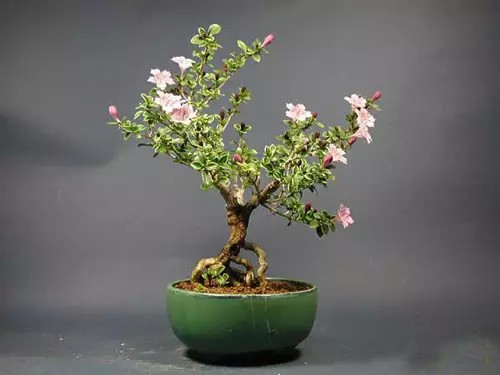
I have cultivated Serissa for 10 years and have discovered some of its characteristics and worked out some experience, which I now share for your reference.
1. Root cultivation can be done by (luring), (sleeving), (tying), (separating), and (replacing).
Serissa roots easily. As long as any part of a young tree touches the ground, new roots will soon grow. Therefore, to propagate Serissa, place small pots filled with growing medium around the mother tree, then bend down strong, well-formed young branches from the mother tree to contact the soil in the pots, inducing new roots. After one growing season, they can be cut from the mother plant and cultivated independently. Such seedlings are vigorous and have a good foundation for shaping.
If cultivating a tall-root tree where roots replace the trunk, plant the young tree in a beverage bottle with the bottom and top removed, and stand the plastic bottle in the pot soil. Once the roots grow down into the pot soil, remove the plastic bottle. Rinse the soil off with water, adjust the root form, tie tightly with rope, then continue sleeving with the plastic bottle and filling with soil until the form is achieved.
If growing roots for a root-over-rock bonsai, use long thin boards to divide the pot soil from top to bottom into three or four tall slots, letting the growing roots descend separately in the slots without tangling with each other, making it easier to use for attaching to rock later.
For a finished Serissa bonsai, if the roots are unsatisfactory, you can use the replace-old-with-new method - that is, induce new roots through ring-barking to shorten or improve them. For a tall-legged tree, you can ring-bark the trunk to induce new roots, then remove the overly long lower portion.
2. The trunk and main support branches should be shaped early by wiring; side branches should be shaped later by pruning.
The older Serissa branches and trunk become, the harder and more brittle they get. Therefore, adjustments to the trunk form should begin with bending in the seedling stage to avoid splitting or breaking. For branch development, let the branches grow to thickness, then "cut the trunk and store the branches," pruning in stages.
3. Branch development is done by padding or pressing.
Because Serissa branches root easily when they touch the ground, you can let the front-end branch that has rooted grow vigorously to accelerate its thickening, while the branch behind the root grows more slowly. Use this principle to adjust branch development - either by pressing branches down or standing them up. If you want to develop a jumping style or a connected clump bonsai, press branches down at fixed points according to the needed curves, distances, and heights to grow roots.
4. Removal and use of adventitious buds.
Serissa continually produces adventitious buds at the base, which consume nutrients, affect the growth of the cultivated stump, and cause chaotic growth that hinders observation of the shape - they must be removed regularly. However, you can also select some thick, strong adventitious buds for cultivation, turning a single-trunk tree into a double-trunk or multi-trunk tree, or to widen, thicken, or deepen a clump.
5. "Oil stars" (small leaves) should flourish in summer and be bare in winter; "water stars" (large leaves) can stay green all year round; "color stars" (gold-edged) should be given nitrogen to bring out their color.